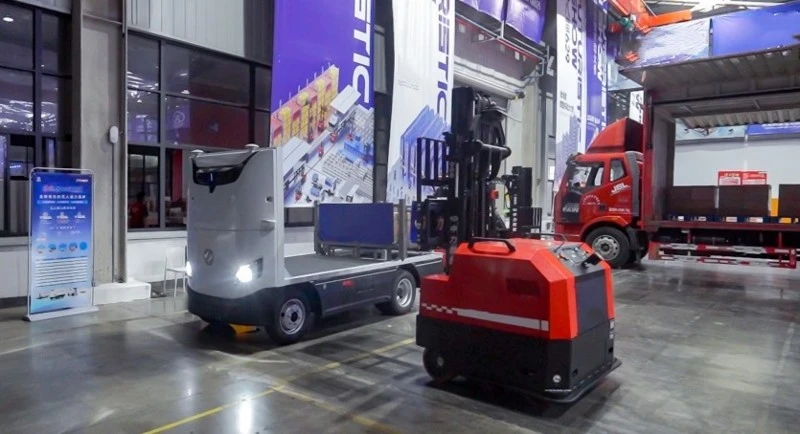
1. Why Autonomous Loading and Unloading Is a Critical Automation Challenge
Loading and unloading remain among the most challenging stages of logistics automation. As the critical connection between external transportation and internal warehouse operations, these processes are essential to improving supply chain efficiency and achieving end-to-end industrial automation.
Unlike structured warehouse storage and picking environments, loading and unloading operations frequently involve non-standard vehicles, inconsistent cargo arrangements, restricted working spaces, and unpredictable environmental conditions. Trucks may park at different angles or heights, pallets may be damaged or misaligned, and enclosed trailers may have poor lighting, dust, and limited navigation references. These variables make it difficult for conventional automated equipment to perform consistently without human intervention.
As logistics operations evolve from basic automation toward intelligent, flexible systems, autonomous loading and unloading is becoming an important application for embodied AI, machine vision, adaptive control, and intelligent mobile robotics.
China JSSL Company focuses on integrated industrial automation and intelligent material-handling solutions, connecting equipment, control systems, and digital platforms to help businesses address complex logistics challenges and improve operational efficiency.
2. Five Major Challenges in Autonomous Loading and Unloading
2.1 Variable Vehicle Positions and Dimensions
Trucks, wing-body vehicles, shipping containers, and railway freight wagons often differ in dimensions, loading heights, and parking positions. Even vehicles of the same type may stop with lateral offsets or angular deviations.
Autonomous equipment must therefore detect vehicle geometry, determine the actual working position, and dynamically adjust its entry and handling trajectory instead of relying entirely on predefined coordinates.
2.2 Difficult Perception in Enclosed Spaces
Inside trailers and containers, limited lighting, dust, changing shadows, and reflective surfaces can reduce the reliability of conventional vision systems. The lack of stable navigation references also makes positioning more difficult.
Combining 3D LiDAR, depth perception, cameras, and sensor fusion can help robots reconstruct their surroundings and maintain reliable positioning in confined environments.
2.3 Irregular Cargo and Damaged Pallets
Cargo may shift during transportation, packaging may become deformed, and pallet fork openings may be partially blocked. Stacked goods can also be uneven or poorly aligned.
These conditions increase the risk of failed fork insertion, cargo damage, and interrupted operations. Intelligent systems must identify cargo geometry, detect abnormalities, and adjust their handling positions to accommodate real-world variations.
2.4 Limited Flexibility of Conventional Automation
Traditional automation equipment is often designed for standardized loading docks, predictable cargo dimensions, and fixed operating procedures. When site conditions differ from the original design assumptions, manual correction may still be necessary.
To achieve reliable unmanned operation, equipment needs adaptive perception, autonomous path planning, dynamic positioning, and flexible handling capabilities.
2.5 Safety, Durability, and Continuous Operation
Confined spaces leave little room for turning or correcting movement. In mixed environments where people and machines may share operating areas, obstacle detection and safety control are particularly important.
Dust, temperature fluctuations, vibration, and other demanding operating conditions also place greater requirements on sensor reliability, mechanical durability, and remote maintenance capabilities.
These challenges demonstrate that autonomous loading and unloading requires more than an unmanned forklift. It requires coordinated perception, planning, control, safety management, and system integration.
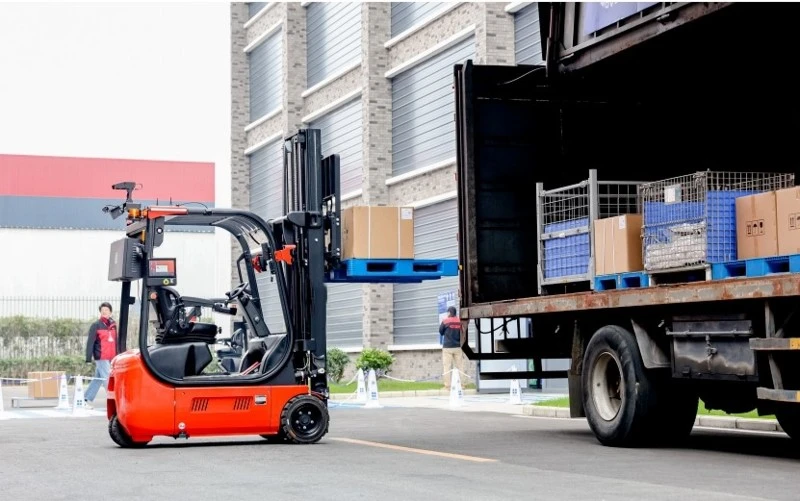
(Autonomous Loading and Unloading Robot)
3. Two Main Technical Approaches
Current autonomous loading and unloading solutions generally follow two technical approaches: purpose-built embodied intelligent equipment and autonomous retrofits based on conventional forklifts.
3.1 Purpose-Built Embodied Intelligent Equipment
Purpose-built systems are designed around specific loading and unloading tasks from the beginning. Their mechanical structures, sensors, movement capabilities, and control systems are developed to address difficult operating conditions such as narrow containers, irregular cargo, and side-loading operations.
Potential advantages include greater freedom of movement, more suitable mechanical configurations, and better adaptation to specialized tasks. Examples include omnidirectional loading robots, container unloading systems, and mobile robots designed for restricted spaces.
These solutions are particularly relevant when conventional forklift structures cannot easily reach the required operating positions or handle complex movement patterns.
3.2 Autonomous Forklift Retrofitting
The retrofit approach retains the basic mechanical structure and lifting principles of a conventional forklift while adding sensors, autonomous navigation, control hardware, and intelligent software.
This approach can make use of existing vehicle designs and established lifting capabilities, potentially reducing the need to develop an entirely new machine. It is especially suitable for applications where the vehicle architecture already matches the handling requirements.
However, the effectiveness of a retrofit depends on the original vehicle structure, sensor configuration, operating environment, and the complexity of the loading task.
3.3 Why Both Approaches Matter
These two approaches are complementary rather than mutually exclusive. Purpose-built equipment can address highly specialized environments, while autonomous forklift retrofits can provide a practical route to automation where conventional vehicle designs remain suitable.
Both approaches rely on a common technical foundation: multimodal perception, 3D spatial understanding, autonomous navigation, motion planning, adaptive control, and safety systems.
The appropriate solution should be selected according to cargo characteristics, vehicle types, operating space, throughput requirements, and the expected level of automation.
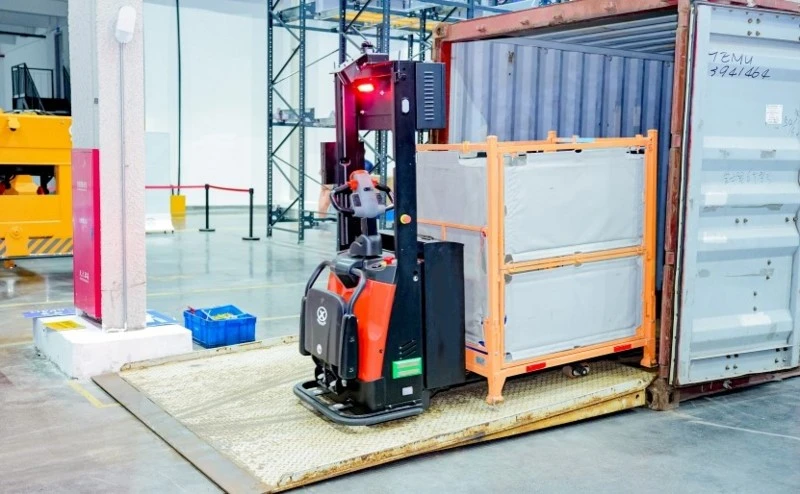
(Autonomous Forklift Retrofit)
4. Five Core Technologies for Intelligent Loading and Unloading
4.1 Adaptive Vehicle Detection and Autonomous Alignment
Before entering a truck or container, an autonomous system must determine the actual position and geometry of the loading area. A combination of 3D LiDAR and visual perception can help identify vehicle orientation, lateral deviation, and loading height.
The system can then generate an appropriate entry trajectory and dynamically compensate for positioning errors during movement.
This capability reduces dependence on perfectly aligned vehicles and standardized docking positions, making autonomous operations more practical in real-world logistics environments.
4.2 AI-Based Mapping and Autonomous Task Planning
Traditional automation often depends on predefined maps, fixed paths, and manually configured operating points. AI-driven autonomous loading systems aim to reduce these dependencies by constructing a three-dimensional representation of the working environment and planning tasks dynamically.
Based on detected cargo positions and available space, the system can determine handling sequences, select suitable approach paths, and adjust its actions as conditions change.
Reducing the need for manual teaching and extensive environment modeling can simplify deployment and improve adaptability across different loading scenarios.
4.3 3D Perception for Low-Light and Confined Environments
Reliable cargo identification is essential when pallets are damaged, fork openings are obstructed, or goods are stacked irregularly.
3D LiDAR, depth sensing, machine vision, and multimodal data processing can help identify cargo positions and geometric features in confined or poorly illuminated spaces. By calculating suitable insertion points and handling trajectories, the system can reduce positioning errors and the risk of collisions or cargo damage.
For container unloading and railway freight operations, this technology is especially valuable because the environment may offer limited clearance and inconsistent visual features.
4.4 Adaptive Motion Control and Precise Handling
Autonomous loading equipment must coordinate driving, steering, lifting, and fork positioning while maintaining stability and avoiding nearby obstacles.
Adaptive motion control can use real-time sensor feedback to adjust movement according to cargo weight, available clearance, vehicle position, and environmental conditions. This helps equipment respond to deviations rather than following a rigid motion sequence.
When integrated with autonomous navigation and intelligent perception, adaptive control improves handling precision, operational continuity, and the ability to work in narrow spaces.
4.5 Remote Operation, Diagnostics, and Maintenance
Unpredictable field conditions can still produce situations that require human assistance. Remote monitoring and intervention allow technical personnel to inspect system status, assist with exceptional situations, and support troubleshooting without always traveling to the operating site.
Combined with event logging, equipment diagnostics, and maintenance alerts, remote support can reduce downtime and improve service efficiency.
For multi-site logistics operations, remote maintenance also provides a foundation for centralized equipment management and more scalable deployment.

(Omnidirectional Material Handling Robot)
5. Building a Complete Autonomous Loading and Unloading Product Portfolio
A comprehensive solution should address the diversity of vehicles, cargo types, and operating environments rather than relying on a single machine design.
Potential application categories include:
Side-loading robots for wing-body trucks: Designed for loading and unloading from the side of a vehicle, with adaptive positioning for varying parking conditions.
Container unloading robots: Built for confined spaces and challenging cargo arrangements inside shipping containers.
Railway freight unloading systems: Designed to operate within enclosed freight wagons and restricted working areas.
Omnidirectional intelligent handling vehicles: Able to maneuver in limited spaces and approach cargo from different directions.
Autonomous forklifts: Suitable for pallet handling, warehouse transportation, and loading tasks where conventional forklift geometry remains effective.
Integrated mobile logistics systems: Connect loading and unloading equipment with AGVs, AMRs, conveyors, storage systems, and warehouse management platforms.
Equipment selection should be based on actual operating requirements, including cargo dimensions, pallet condition, load capacity, cycle time, vehicle access, and site layout.
China JSSL Company emphasizes engineering integration and application-specific solution design, helping businesses evaluate equipment configurations and connect material-handling processes with broader warehouse automation systems.
6. From Single-Machine Automation to End-to-End Logistics Integration
One of the greatest challenges in autonomous loading and unloading is connecting individual machines into a coordinated logistics workflow.
A loading robot may operate effectively on its own, but overall performance remains limited if vehicle arrival information, dock availability, warehouse inventory, and internal transportation are managed separately.
An integrated architecture can connect the following systems:
TMS (Transportation Management System): Provides transportation plans, vehicle schedules, and arrival information.
Dock management systems: Coordinate dock assignment, availability, and loading or unloading priorities.
WMS (Warehouse Management System): Manages inventory, storage locations, and warehouse tasks.
WCS (Warehouse Control System): Coordinates automated equipment and material-handling activities.
ERP and MES platforms: Connect logistics execution with enterprise operations and manufacturing requirements.
AGV and AMR fleet management: Coordinates internal transportation between docks, staging areas, and storage locations.
When these systems exchange information in real time, the operation can move beyond isolated machine automation toward a connected process: vehicle arrival, dock assignment, autonomous unloading, internal transportation, inventory updating, and subsequent material delivery.
The main technical challenge lies in integrating different communication protocols, data formats, and equipment interfaces while maintaining reliable responses to changing operational conditions.
A unified data architecture and coordinated scheduling mechanism can reduce information silos, improve resource utilization, and support more flexible logistics operations.
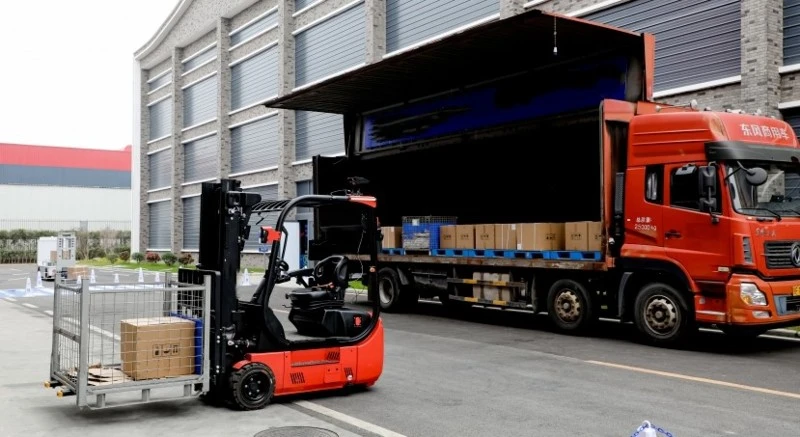
(Intelligent Material Handling Solutions)
7. Future Trends: Embodied AI, Multi-Robot Collaboration, and Adaptive Operations
Over the next three to five years, autonomous loading and unloading is expected to develop in three important directions.
7.1 From Task Execution to Intelligent Decision-Making
Embodied AI is expected to improve robots' ability to understand their surroundings, interpret task requirements, and adapt to unfamiliar situations.
Instead of executing only predefined sequences, future systems may increasingly determine handling strategies, generate movement plans, and learn from operational data. This could reduce the amount of manual configuration required for each new environment.
7.2 Multi-Robot Coordination Across the Logistics Chain
Future logistics automation will increasingly connect loading robots, autonomous forklifts, AMRs, warehouse equipment, and dock management systems.
Coordinated workflows could support the complete sequence from unloading and pallet transfer to internal transportation and storage. Connecting these activities with vehicle scheduling, inventory management, and production planning can help reduce delays between individual processes.
7.3 Greater Adaptability to Non-Standard Cargo and Environments
Adaptive control and advanced perception will continue to develop to accommodate damaged pallets, irregularly shaped goods, changing light conditions, dust, and other difficult operating conditions.
Remote diagnostics and autonomous recovery capabilities may also improve equipment availability and reduce the need for on-site intervention.
The long-term direction is a shift from requiring every cargo item and operating environment to conform to fixed equipment standards toward systems that can adapt to the actual conditions encountered in the field.
8. Conclusion: Connecting the Final 100 Meters of Logistics
Autonomous loading and unloading is a critical step toward fully connected logistics automation. Its challenges extend beyond vehicle movement and cargo handling to include environmental perception, adaptive control, safety, system interoperability, and operational coordination.
Purpose-built embodied intelligent equipment and autonomous forklift retrofits will continue to serve different application requirements. Their effectiveness depends on selecting the appropriate technical architecture and integrating it with warehouse operations, transportation management, and internal material flows.
Through integrated engineering, intelligent material-handling design, and warehouse system connectivity, China JSSL Company supports the development of flexible logistics automation solutions for diverse industrial applications. As AI, 3D perception, and multi-robot coordination continue to advance, autonomous loading and unloading will become an increasingly important part of efficient, scalable, and intelligent supply chains.