

As e-commerce growth and digital transformation continue to reshape the information technology industry, many ICT distributors face increasing challenges related to warehouse space utilization, order processing speed, and labor costs. To overcome these operational bottlenecks and support business growth, a leading ICT distribution enterprise partnered with China JSSL Company to deploy a high-density automated storage and order fulfillment solution.
By implementing an advanced Goods-to-Person (GTP) system and intelligent warehouse automation technologies, the company successfully transformed its distribution center into a highly efficient and scalable logistics operation.
Background
The company is a major distributor and manufacturer of information and communication technology products, supplying a wide range of computing devices, networking equipment, electronic components, and IT peripherals through an extensive reseller network.
With thousands of product categories and a rapidly growing customer base, the enterprise experienced significant growth in order volume. As demand increased, the existing warehouse faced several operational challenges:
Limited warehouse capacity
Increasing order fulfillment pressure
Rising labor costs
Growing SKU complexity
Reduced picking efficiency
Higher operational expenses
To support future business expansion, the company decided to upgrade its logistics infrastructure and introduce a modern warehouse automation solution capable of improving productivity while maximizing storage density.
Warehouse Challenges
The distribution center managed approximately 8,500 SKUs, ranging from large server racks and displays to small electronic components and accessories.
As online demand surged, warehouse operations became increasingly strained. Traditional manual picking methods required employees to travel long distances throughout the facility, resulting in:
Slow order fulfillment
Labor-intensive operations
Inventory management difficulties
Limited storage scalability
Reduced operational flexibility
The company required a solution that could:
Increase storage capacity without expanding warehouse space
Improve picking speed and accuracy
Reduce labor dependency
Support future business growth
Enhance inventory visibility
After extensive evaluation, China JSSL Company proposed a high-density Automated Storage and Retrieval System (AS/RS) integrated with a Goods-to-Person picking model.

(Smart Warehouse Solution)
Intelligent Warehouse Automation Solution
The implemented solution utilizes an advanced cube-based storage architecture designed to maximize warehouse space utilization.
The system includes:
Intelligent warehouse robots
Automated storage grid structure
Goods-to-Person (GTP) picking stations
Smart inventory management software
Warehouse Control System (WCS)
Warehouse Management System (WMS)
The project was completed within a short deployment timeframe, minimizing disruption to ongoing operations.
System Operation
Automated Storage
Incoming products are transferred from receiving areas into storage bins managed by intelligent warehouse robots.
The robots automatically transport storage bins to available locations within the high-density storage grid, optimizing warehouse capacity and inventory organization.
Automated Order Picking
When customer orders are released, intelligent robots retrieve the required bins and deliver them directly to Goods-to-Person workstations.
Instead of warehouse operators walking throughout the facility searching for products, inventory is automatically brought to them.
This significantly improves:
Picking productivity
Order accuracy
Labor efficiency
Employee ergonomics
Automatic Replenishment and Returns Processing
The solution also streamlines inventory replenishment and reverse logistics processes.
Returned products can be quickly reintroduced into inventory through automated storage workflows, improving stock accuracy and reducing processing times.

(Distribution Center Automation)
Key Project Highlights
1. Significant Picking Efficiency Improvements
One of the most important outcomes of the project is the dramatic increase in order fulfillment productivity.
With the Goods-to-Person model:
One operator can perform the work previously completed by four to five employees.
Product search time is virtually eliminated.
Order processing speed is substantially improved.
For large orders involving multiple product categories, processing times that previously required several hours can now be completed within a fraction of the original timeframe.
The distribution center also achieved several times higher order-line throughput compared to traditional manual operations.
2. High-Density Storage Optimization
A major advantage of the solution is its ability to maximize available warehouse space.
The intelligent storage grid significantly increases storage density, enabling the company to accommodate business growth without relocating to a larger facility.
This helps reduce:
Facility expansion costs
Warehouse rental expenses
Infrastructure investment requirements
The project demonstrates the effectiveness of modern high-density warehouse storage systems in maximizing operational efficiency.
3. Improved Inventory Accuracy and Security
The automated system provides precise inventory tracking and continuous stock visibility.
Benefits include:
Real-time inventory management
Automated cycle counting
Enhanced stock accuracy
Improved product traceability
Restricted inventory access for greater security
The integration with enterprise resource planning systems further strengthens operational control.
4. Flexible Scalability
As business volumes continue to grow, the solution can be expanded easily by:
Adding more robots
Increasing storage bins
Expanding storage grids
Adding additional workstations
This modular architecture supports long-term growth while minimizing operational disruption.
5. Sustainable Logistics Operations
The intelligent robotic system utilizes energy-efficient technologies that significantly reduce power consumption compared to traditional warehouse automation systems.
As sustainability becomes increasingly important in supply chain management, energy-efficient warehouse operations contribute to both environmental and financial objectives.

(High-Density Storage)
Project Results
Following implementation, the automated warehouse delivered measurable business improvements.
Enhanced Productivity
The Goods-to-Person picking model dramatically improved warehouse throughput and order fulfillment efficiency.
Increased Storage Capacity
High-density storage significantly increased inventory capacity without requiring additional warehouse space.
Reduced Labor Requirements
Automation reduced dependency on manual labor while improving workplace ergonomics and employee productivity.
Improved Customer Service
Faster order processing enables the company to provide more responsive service to customers and channel partners.
Future-Ready Infrastructure
The scalable warehouse automation platform positions the company for continued business growth and digital transformation.
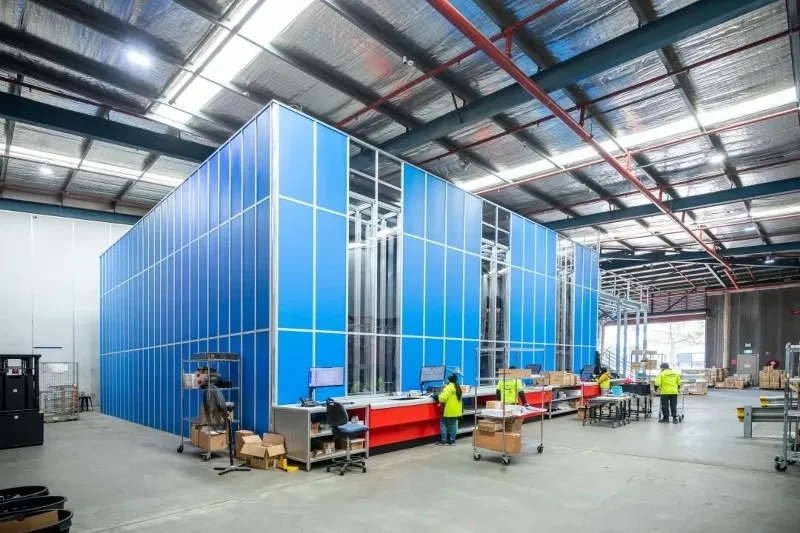
(Robotics Warehouse Solution)
Supporting the Future of Smart Logistics
Through collaboration with China JSSL Company, the enterprise successfully transformed its traditional warehouse into a modern intelligent fulfillment center.
The project demonstrates how technologies such as:
Warehouse Automation
Goods-to-Person Picking
Automated Storage Systems
Smart Logistics Solutions
Digital Supply Chain Management
Intelligent Distribution Centers
can help businesses improve operational performance while creating a foundation for future expansion.
As demand for faster and more accurate order fulfillment continues to rise, intelligent warehouse automation will remain a critical driver of supply chain competitiveness.