

As manufacturing enterprises continue to expand production capacity, challenges such as slow material flow, rising warehouse management costs, and increasing labor expenses have become more prominent. To address these issues and accelerate digital transformation, a leading fine chemical manufacturer partnered with China JSSL Company to implement an advanced intelligent warehouse automation solution. By integrating AI-powered logistics technologies, Automated Storage and Retrieval Systems (AS/RS), Autonomous Mobile Robots (AMR), and intelligent warehouse management software, the company successfully established a highly automated and digitally connected logistics ecosystem.
Background: Accelerating Smart Manufacturing Through Warehouse Automation
Founded as a high-tech enterprise specializing in nutritional ingredients, flavors and fragrances, pharmaceutical intermediates, and advanced materials, the company has developed multiple production bases across China. As business volumes continued to grow, traditional warehousing and material handling methods gradually became insufficient to support increasing operational demands.
Warehouse operations faced several common challenges:
Increasing material handling workload
Rising labor and logistics costs
Complex inventory management requirements
Heavy material transportation risks
Slow response to production demands
Limited warehouse visibility and traceability
To support its long-term Industry 4.0 and Smart Factory strategy, the company initiated a comprehensive digital transformation program, with warehouse automation identified as a critical component of future growth.
Working alongside China JSSL Company, the enterprise launched a new intelligent logistics project designed to improve efficiency, strengthen inventory control, and create a seamless connection between manufacturing and warehousing operations.

(Smart Factory)
Intelligent Warehouse Project Overview
The new intelligent warehouse was designed as an integrated component of the manufacturing campus, directly supporting production operations.
The facility features:
Approximately 10,000 square meters of warehouse space
Warehouse height reaching 30 meters
Seven automated storage aisles
Nearly 15,000 pallet storage locations
Ambient-temperature storage areas for raw materials and packaging
Controlled-temperature storage areas for finished products
Through the implementation of advanced Warehouse Automation Solutions, the project enables fully automated material movement from raw material receiving through finished product shipping.
The entire warehouse is managed through an integrated digital platform that synchronizes inventory information, production schedules, and logistics operations in real time.
As a result, operational efficiency has improved by more than 50% compared to conventional warehouse management methods.

(Industrial Automation)
Integrated Smart Logistics Architecture
To support end-to-end automation, China JSSL Company deployed a comprehensive combination of intelligent logistics technologies, including:
Automated Storage and Retrieval Systems (AS/RS)
Autonomous Mobile Robots (AMR)
Intelligent Robotic Arms
Vision-Based Depalletizing Systems
Warehouse Management System (WMS)
Warehouse Control System (WCS)
Manufacturing Execution System (MES) Integration
AIoT Smart Logistics Platform
Together, these technologies create a fully connected Digital Supply Chain Management environment.
Automated Material Flow Process
Raw Material Receiving and Storage
Incoming raw materials are automatically palletized using robotic systems before being transferred through conveyor lines into the automated warehouse.
Key benefits include:
Reduced manual handling
Improved inventory accuracy
Faster receiving operations
Enhanced workplace safety
Automated Raw Material Delivery
When production lines generate material requests through the ERP system, automated stacker cranes retrieve the required pallets from storage.
AMRs then transport materials directly to designated production areas without human intervention.
This process significantly reduces response times while ensuring uninterrupted production operations.
Finished Goods Storage
After production is completed, finished products are automatically conveyed to robotic palletizing stations.
The palletized goods are then transported into the AS/RS warehouse for high-density storage.
This automated process improves storage efficiency while minimizing product handling risks.
Automated Order Fulfillment
For outbound logistics, full-pallet orders are automatically retrieved and delivered to shipping stations.
For mixed orders requiring partial quantities, AI-powered robotic arms perform automated depalletizing and order consolidation before shipment.
The result is a highly flexible and efficient Order Fulfillment System capable of handling diverse customer requirements.

(Automated Material Handling)
Key Project Innovations
1. AI-Powered High-Bay Stacker Cranes
One of the most impressive aspects of the project is the deployment of ultra-high stacker cranes operating within a 30-meter warehouse environment.
The system incorporates:
AI-based visual inspection
Foreign object detection
Cargo loss monitoring
Predictive maintenance
Remote diagnostics
3D warehouse monitoring
These features significantly enhance operational reliability and safety.
2. Intelligent Vision-Guided Robotic Arms
Unlike conventional robotic systems that follow predefined programming paths, AI-powered robotic arms utilize machine vision technology to:
Identify product shapes
Detect pallet patterns
Locate products automatically
Execute dynamic picking operations
This technology enables automated depalletizing and order assembly with high accuracy.
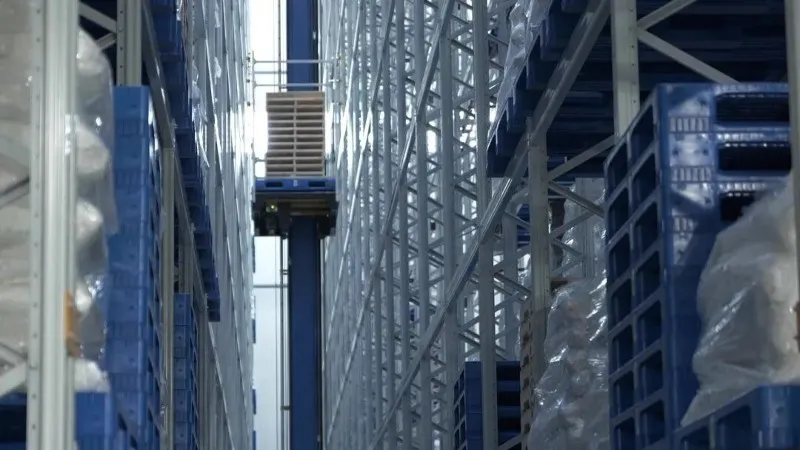
(High-Bay Warehouse)
3. Automated Receiving System
To support multiple inbound material formats, the project integrates:
Telescopic conveyors
Intelligent robotic palletizers
Material shaping systems
For soft-packaged products, specialized equipment automatically adjusts product positioning before palletizing, improving stacking stability and reducing product damage.
4. End-to-End Manufacturing and Warehouse Integration
One of the most valuable aspects of the project is the seamless integration between production and warehouse operations.
Through the intelligent logistics platform developed with China JSSL Company, data is shared between:
ERP systems
MES systems
Laboratory Management Systems (LIMS)
Warehouse Management Systems (WMS)
Warehouse Control Systems (WCS)
This integrated architecture allows real-time coordination between manufacturing and logistics operations, ensuring accurate material supply and inventory visibility.

(Automated Material Handling)
Business Benefits and Results
Since implementation, the intelligent warehouse has generated substantial operational improvements.
Increased Operational Efficiency
Warehouse and production activities are now fully synchronized, resulting in:
More than 50% improvement in operational efficiency
Faster material delivery
Reduced production downtime
Improved inventory turnover
Maximized Space Utilization
The high-density automated storage system significantly increases storage capacity while minimizing facility footprint.
The project achieves nearly 100% effective utilization of available warehouse space.
Improved Safety and Compliance
Automation reduces manual material handling, lowering workplace risks and improving compliance with GMP manufacturing requirements.
Reduced Labor Dependency
Automated transportation and storage systems greatly reduce the need for labor-intensive warehouse activities, helping address workforce shortages and rising labor costs.
Flexible and Scalable Infrastructure
The project follows a "standardized hardware, modular software" design philosophy, allowing future expansion as business requirements continue to evolve.

(End-to-End Logistics Solution)
Supporting the Future of Smart Manufacturing
The intelligent warehouse project demonstrates how advanced logistics automation can become a strategic driver of manufacturing transformation.
Through collaboration with China JSSL Company, the enterprise successfully established a highly automated logistics ecosystem that combines Smart Warehousing, Industrial Automation, AI Logistics Solutions, and Digital Supply Chain Management into a unified operational platform.
As manufacturers continue to pursue digital transformation and operational excellence, intelligent warehouse solutions such as this will play an increasingly important role in building efficient, scalable, and future-ready production environments.