

As food safety requirements become increasingly stringent and consumer demand continues to evolve, finished-goods logistics is becoming a critical part of production efficiency, inventory management, and compliant operations in the food and beverage industry.
For manufacturers handling high production volumes, heavy pallet loads, multiple SKUs, seasonal demand fluctuations, and temperature-sensitive products, traditional manual transportation can create bottlenecks between production lines, warehouses, and shipping areas.
China JSSL Company provides integrated intelligent logistics solutions designed to connect production, storage, transportation, and dispatch operations. Leveraging China's mature manufacturing supply chain and automation engineering capabilities, China JSSL Company delivers customized warehouse automation equipment, conveying systems, RGV solutions, pallet handling systems, and logistics system integration for food and beverage manufacturers.
Four Capabilities Supporting Intelligent Finished-Goods Logistics
An effective logistics automation system needs to do more than simply replace manual transportation. It must operate continuously, connect different production and warehouse processes, and adapt to changing production requirements.
China JSSL Company focuses on four core capabilities:
High Efficiency & Stability
Multiple automated devices can operate collaboratively around the clock, supporting high-throughput transportation between production lines, warehouses, and shipping areas.
Precise Process Integration
Automated positioning and control allow logistics equipment to connect production lines, automated storage systems, and outbound stations with greater accuracy and consistency.
Cost Reduction & Operational Quality
Automation reduces repetitive manual transportation, lowers labor dependence, and helps minimize human errors and handling-related product damage.
Flexible Customization
Equipment configuration can be adapted to factory layout, production rhythm, load requirements, warehouse structure, and different product characteristics.
This combination of equipment manufacturing and system integration enables China JSSL Company to develop solutions around the customer's actual production and logistics processes rather than simply supplying individual machines.
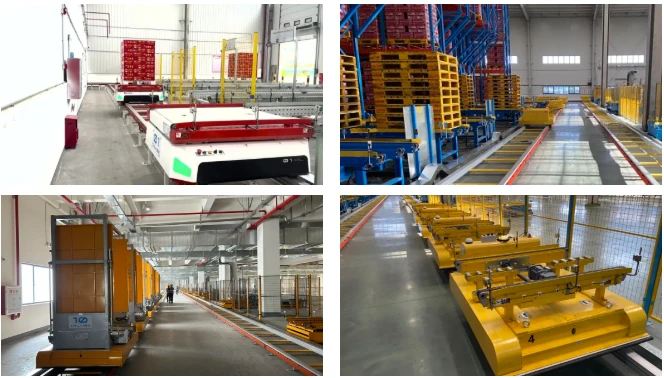
(Heavy-Duty RGV System)
Customized Solutions for Different Food & Beverage Segments
Different food products create different challenges for finished-goods logistics. High-speed beverage production requires high throughput, while alcoholic beverages require heavy-load and low-impact transportation. Seasonings require accurate batch management, and frozen food requires equipment capable of operating reliably in low-temperature environments.
Beverage Manufacturing: High-Speed RGV Logistics
Beverage production is characterized by high output, fast production cycles, and significant fluctuations between peak and off-peak seasons.
After packaging, finished products need to be transported efficiently to automated warehouses and shipping areas. If this process relies heavily on forklifts or manual handling, transportation capacity can become a bottleneck during seasonal peaks and promotional periods.
An RGV automated transport system can connect different production and warehouse areas while coordinating multiple vehicles according to actual logistics demand.
The system can dynamically allocate transportation capacity according to order volume, helping manufacturers maintain stable inbound, storage, and outbound operations even during peak demand.
Alcoholic Beverages: Heavy-Load Pallet Handling
Alcoholic beverage products often have relatively high pallet weights and packaging that can be vulnerable to impact during transportation.
Traditional forklift handling may increase the risk of collisions, unstable positioning, and packaging damage.
For these applications, heavy-duty RGV systems and pallet handling equipment can provide controlled and automated transportation. Precise positioning and smooth transfer allow full pallets of finished products to move between production, storage, and dispatch areas with reduced manual intervention.
The result is not simply higher automation-it is a more stable material flow with lower dependence on manual forklift operations.
Seasonings: Accurate Multi-SKU and Batch Handling
Seasoning manufacturers often manage numerous product varieties and production batches. Manual transportation can make it difficult to maintain accurate product separation, increasing the risk of mixed batches or incorrect warehouse placement.
An integrated automated logistics system can automatically route finished products to the corresponding storage locations and outbound channels.
By connecting conveying equipment, pallet handling systems, warehouse management processes, and automated storage locations, manufacturers can achieve more controlled multi-SKU and batch logistics management.
This is particularly valuable for food manufacturers seeking to improve inventory accuracy while reducing operational complexity.
Frozen Food: Automation in Low-Temperature Warehouses
Frozen food logistics presents another challenge. Finished products are commonly stored in cold rooms operating at approximately -18°C to -25°C, where prolonged manual operation can create difficult working conditions.
Frequent personnel movement in and out of cold storage can also affect the warehouse environment and operational efficiency.
For low-temperature applications, logistics equipment requires appropriate component selection and environmental adaptation to maintain stable operation.
China JSSL Company can integrate automated conveying, pallet handling, RGV transportation, and warehouse logistics systems according to low-temperature operating conditions, helping food manufacturers automate finished-goods transportation while reducing unnecessary personnel movement inside cold storage areas.
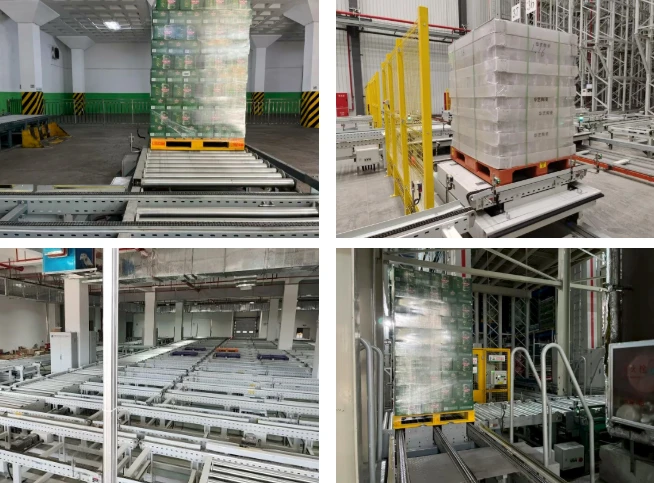
(Warehouse Automation Equipment)
System Integration: Connecting Production, Storage and Distribution
For modern food manufacturers, automation equipment should not operate as isolated machines.
The real value comes from integrating different equipment and processes into a unified logistics system.
A complete solution can connect:
Production Line → Conveying System → RGV/Pallet Handling → Automated Warehouse → Sorting & Dispatch → Shipping
Through communication between equipment control systems and warehouse management platforms, production and logistics data can be coordinated more effectively.
This allows manufacturers to improve material flow visibility, optimize warehouse utilization, and respond more efficiently to changing production and order requirements.
As a China-based intelligent logistics equipment manufacturer and system integrator, China JSSL Company combines equipment manufacturing, engineering design, automation control, project implementation, and logistics system integration to provide complete solutions for international customers.
From Equipment Supply to Full-Cycle Service
For overseas food and beverage manufacturers, successful automation projects require more than equipment delivery.
China JSSL Company follows an integrated "equipment + engineering + service" approach covering the complete project lifecycle.
Before Implementation:
Site surveys, process analysis, logistics planning, equipment selection, and customized system design.
During Project Delivery:
Equipment manufacturing, installation, system commissioning, integration testing, and operator training.
After Commissioning:
Technical support, preventive maintenance, troubleshooting, system optimization, and functional upgrades.
This full-cycle approach helps customers transform individual automation equipment into a reliable and continuously operating intelligent logistics infrastructure.

(Automated Warehouse Logistics)
Building the Next Generation of Food Logistics
As food safety, production efficiency, labor costs, and supply-chain visibility become increasingly important, intelligent finished-goods logistics will play a larger role in the competitiveness of food and beverage manufacturers.
The future is not simply about replacing forklifts or manual handling with automated equipment. It is about creating an integrated logistics environment connecting production, warehousing, transportation, inventory, and distribution.
With China's advanced manufacturing capabilities, mature automation supply chain, engineering experience, and system integration resources, China JSSL Company is positioned to provide customized intelligent logistics solutions for beverage, alcoholic beverage, seasoning, frozen food, and other food manufacturing applications.
From a single RGV system to a complete automated warehouse logistics solution, the goal is clear: reduce manual dependency, improve logistics efficiency, strengthen operational stability, and build scalable smart logistics infrastructure for global food manufacturers.