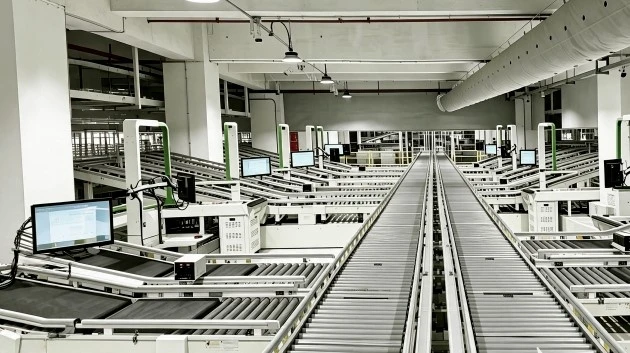
1. Project Background
With the rapid growth of e-commerce, express delivery, and intelligent manufacturing, logistics centers are facing increasing demands for sorting efficiency, operational accuracy, and automation.
Traditional parcel sorting systems perform well when handling standardized packages. However, irregular parcels, soft packages, damaged labels, reflective surfaces, and randomly oriented barcodes create significant challenges for conventional sorting equipment.
Manual identification and sorting also increase labor requirements and make it difficult to maintain stable operational efficiency during peak periods.
To address these challenges, intelligent logistics systems are increasingly integrating AI vision recognition, Optical Character Recognition (OCR), edge computing, and automated sorting technologies.
China JSSL Company focuses on intelligent logistics automation and system integration, providing customized solutions designed to improve parcel identification, material handling, and sorting operations.
2. Project Challenges
In complex logistics environments, parcel sorting systems must overcome several technical and operational difficulties.
Irregular Parcel Recognition
Packages vary significantly in shape, size, material, and surface condition.
Irregular parcels and soft packages may not follow standardized positioning requirements, making conventional scanning and sorting methods less effective.
The system requires reliable visual recognition capabilities to identify parcels under changing conditions.
Barcode and OCR Identification
Parcel labels may appear on different surfaces and orientations.
Reflective materials, damaged labels, wrinkles, and overlapping packages can interfere with barcode scanning and OCR recognition.
The system must collect and process visual information from multiple surfaces to improve identification reliability.
High-Speed Sorting Requirements
Modern distribution centers handle large volumes of parcels within limited operating time.
The identification system must process visual information quickly and coordinate with downstream sorting equipment.
Delays in recognition or communication can affect the overall sorting workflow.
Multi-Machine Coordination
Large sorting systems contain multiple sorting units, conveying modules, sensors, and control components.
Maintaining stable communication and synchronized operation between these devices is essential for efficient system performance.
3. Intelligent Sorting System Solution
To address these operational challenges, an integrated intelligent sorting solution combines AI vision recognition, OCR processing, automated conveying, and coordinated sorting control.
The system is designed to connect parcel identification with sorting execution, creating a more flexible and intelligent logistics workflow.
AI Vision Recognition
AI vision technology enables the system to analyze parcel images and extract relevant visual characteristics.
Through image processing and feature recognition, the system can identify package information under different lighting conditions, orientations, and surface appearances.
The recognition process supports the identification of irregular parcels and helps reduce dependence on fixed scanning positions.
Multi-Surface Scanning and OCR
A distributed camera arrangement collects visual information from multiple parcel surfaces.
The system combines image acquisition and OCR processing to identify shipping labels, barcodes, and other classification information.
Multi-surface recognition helps address situations where parcel labels are not positioned consistently.
The visual identification process can be configured according to parcel dimensions, label locations, and operational requirements.
Intelligent Parcel Classification
After collecting parcel information, the system analyzes the identified characteristics and determines the appropriate sorting destination.
AI-based classification and visual information processing help connect parcel identification with downstream sorting operations.
This approach supports flexible sorting workflows and improves the handling of different parcel categories.
Edge Computing and Real-Time Control
Edge computing allows visual processing and control functions to operate closer to the sorting equipment.
This reduces dependence on centralized processing for time-sensitive operations and supports faster communication between recognition modules and sorting units.
The system can integrate cameras, computing devices, sensors, and control equipment into a coordinated automation architecture.
Multi-Machine Coordination
The intelligent sorting system connects multiple conveying and sorting units through an integrated control structure.
Coordinated communication enables different equipment modules to exchange operational information and execute sorting tasks.
The control architecture can be configured according to the number of sorting units, processing requirements, and logistics center layout.
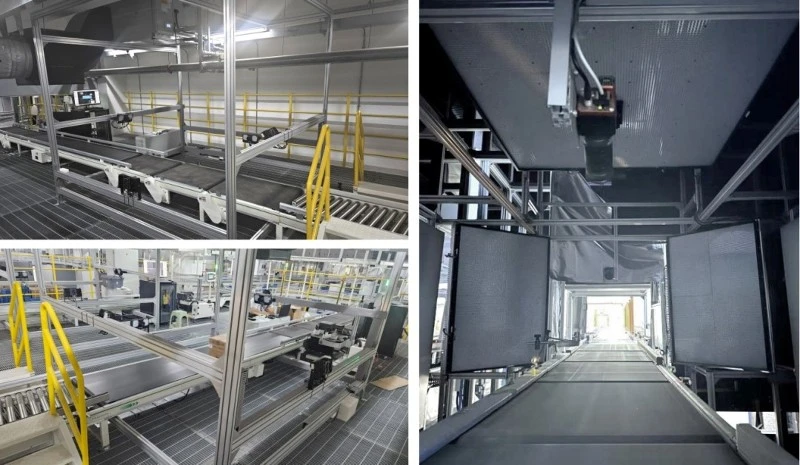
(AI OCR Parcel Recognition)
4. System Integration and Implementation
The implementation of an intelligent sorting system requires coordination between visual recognition technology, mechanical equipment, control systems, and logistics processes.
The overall system configuration can be customized according to the customer's operational environment.
Key considerations include:
Parcel dimensions and package characteristics
Required sorting capacity
Barcode and OCR identification requirements
Camera installation positions
Conveyor and sorting equipment configuration
Communication between sorting units
Available workshop space
Integration with existing logistics systems
Through customized system integration, different equipment modules can work together to support parcel identification, classification, conveying, and sorting.
The solution is suitable for logistics centers seeking to upgrade existing sorting operations or establish new automated sorting facilities.
5. Application Scenarios
E-Commerce and Express Logistics
E-commerce distribution centers handle large quantities of parcels with different sizes, packaging materials, and shipping labels.
AI vision recognition and automated sorting help improve parcel identification and support more efficient processing during peak periods.
Intelligent Manufacturing
Manufacturing facilities require accurate identification and transportation of components, finished products, and production materials.
Intelligent vision systems can support automated material classification and internal logistics operations.
Pharmaceutical Logistics
Pharmaceutical distribution requires reliable identification and traceability of products.
OCR and visual inspection technologies can support package identification, label verification, and automated sorting processes.
System configuration must be adapted to the operational and regulatory requirements of the pharmaceutical environment.
Fresh Food and Cold Chain Logistics
Fresh food logistics involves products with different packaging characteristics and handling requirements.
Automated visual identification combined with appropriate conveying and sorting equipment can support more organized processing and reduce unnecessary manual handling.
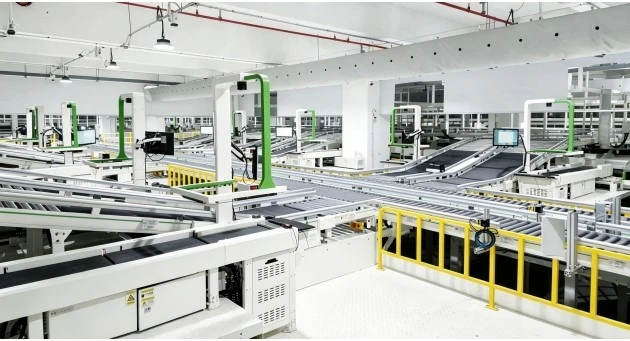
(Automated Distribution Center)
6. Project Benefits
The integration of AI vision recognition and intelligent sorting technologies offers several potential operational advantages.
Improved Parcel Recognition
Multi-surface image acquisition and AI-based visual processing help address irregular package shapes, different label orientations, and complex parcel appearances.
More Efficient Sorting Operations
Automated identification and classification reduce the need for repeated manual scanning and support continuous parcel processing.
Flexible Handling of Irregular Parcels
The system can be configured to accommodate different package dimensions and visual characteristics, improving flexibility in non-standard logistics environments.
Better Equipment Coordination
Integrated control and communication enable conveying, recognition, and sorting modules to work together more efficiently.
Support for Logistics Automation Upgrades
The system provides a foundation for integrating intelligent recognition technology into existing logistics facilities and future automated sorting projects.
7. Future Development
AI vision recognition and OCR technologies are continuing to evolve toward more intelligent and integrated logistics applications.
Future sorting systems will increasingly combine machine vision, edge computing, intelligent control, and robotic handling.
The integration of multiple sensing technologies will help improve parcel recognition under complex conditions.
Meanwhile, modular equipment design and flexible control architectures will support easier system expansion and customization.
For logistics operators, the development of intelligent sorting technology represents an important step toward improving operational efficiency, reducing repetitive manual work, and building more adaptable logistics infrastructure.
Conclusion
AI vision-based intelligent sorting systems provide a practical approach to addressing the challenges of irregular parcel recognition, barcode identification, high-speed sorting, and multi-machine coordination.
By integrating visual recognition, OCR, edge computing, and automated sorting equipment, logistics centers can establish more flexible and efficient parcel processing workflows.
China JSSL Company provides intelligent logistics automation and system integration solutions tailored to customer requirements, supporting the development of automated conveying, sorting, and warehouse logistics systems.
China JSSL Company – Intelligent Logistics Automation and System Integration Solutions