Industrial robots play an increasingly important role in modern manufacturing and intralogistics. Depending on their installation and operating methods, industrial robot applications can generally be divided into two main categories: fixed industrial robots and mobile robots.
This article focuses on sensor solutions for fixed industrial robots and their role in improving workplace safety, workpiece detection, and automated production accuracy.
Fixed industrial robots are permanently installed systems designed to perform automated tasks in manufacturing facilities, logistics centers, and laboratories. Typical applications include welding, bonding, assembly, painting, inspection, sorting, picking, and palletizing.
With high repeatability and reliable process performance, fixed robots are particularly suitable for standardized production processes that require consistent accuracy and efficiency. To ensure safe and stable operation, however, these systems also require appropriate sensing and protective technologies.
1. Key Sensor Applications in Fixed Industrial Robot Systems
In fixed robot cells and robot-assisted production units, sensor technology mainly serves two purposes:
Safety protection: Monitoring access points, detecting personnel, and protecting hazardous working areas.
Workpiece detection and positioning: Identifying material presence, checking workpiece conditions, and supporting accurate automated handling.
The integration of suitable sensors helps manufacturers improve personnel protection, reduce operational risks, and maintain reliable production processes.
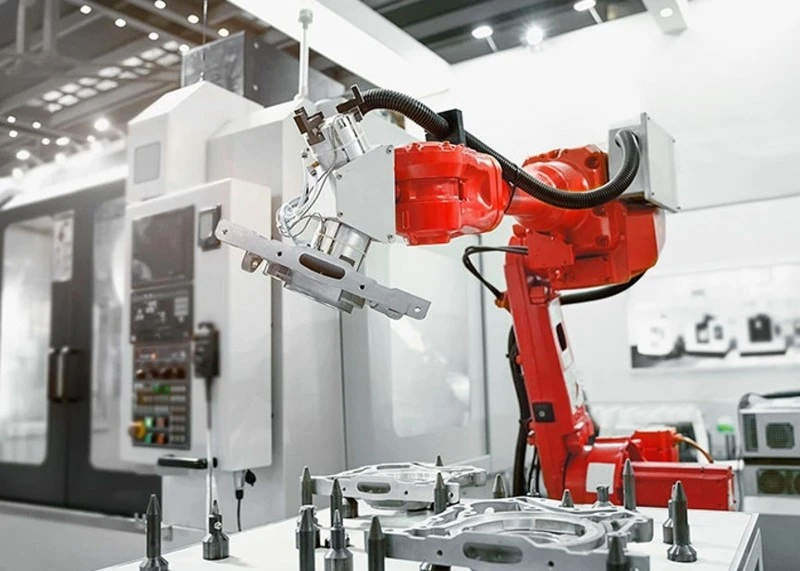
(Fixed Industrial Robot Sensors)
2. Safety Protection for Fixed Industrial Robots
Industrial robot work cells often involve high-speed movements and repetitive operations. Without appropriate protective measures, personnel entering hazardous areas may face significant safety risks.
Sensor-based safety solutions can monitor access points, detect human presence, and help prevent machinery from restarting when personnel remain inside protected areas.
2.1 Access Protection for Interconnected Robot Cells
Application requirements
In interconnected robot cells, such as those used in battery manufacturing, components are frequently transported between production stations through conveyor systems. All material entry and exit points must be protected to prevent unauthorized access to hazardous areas.
Sensor solution
Multi-beam safety light curtains, such as the MLD 500 series used in this type of application, can be installed along conveyor access points to detect personnel entering protected zones.
Depending on the production process, a muting function can be configured to distinguish permitted material transportation from personnel access. Configuration through pin assignment can simplify installation and system integration.
This approach allows manufacturers to maintain safety protection while supporting continuous material flow between automated production stations.
2.2 Safety Protection for Narrow Access Openings
Application requirements
Some robot work cells require operators to replenish materials or consumables at regular intervals. Access openings must therefore be designed to support convenient material handling while preventing personnel from reaching hazardous machine areas.
The challenge is to maintain reliable protection without introducing unnecessary interruptions to production.
Sensor solution
Compact, high-resolution safety light curtains, such as the MLC 500 and ELC 100 product series, can be used to protect narrow access openings.
These devices are designed to detect the presence of fingers and hands within the protected area. Depending on the model, the protection field can reach up to 3,000 mm for the MLC 500 and 1,500 mm for the ELC 100.
Their compact structures and different protection field configurations provide flexibility for various machine layouts and material replenishment requirements.
2.3 Restart Protection and Blind-Spot Monitoring
Application requirements
Before a robot system restarts, manufacturers must ensure that no personnel remain inside the working area or concealed hazardous zones.
This is particularly important in complex production environments where machine structures, equipment components, or other obstacles can create blind spots. Safety systems must also maintain reliable operation in demanding environments involving dust, contamination, and welding sparks.
Sensor solution
Three-dimensional safety radar systems, such as the LBK 3D series, can be configured to monitor personnel presence within defined protection zones.
By detecting human presence, including stationary individuals, these systems can help address areas that may not be adequately covered by conventional access protection devices.
Detection angles and distances can be adjusted according to the installation environment. A single controller can support up to six sensors, making it possible to monitor larger or more complex industrial layouts.
When properly integrated into the machine safety architecture, 3D radar systems can support restart interlocking and blind-spot monitoring, helping prevent unintended machine startup.
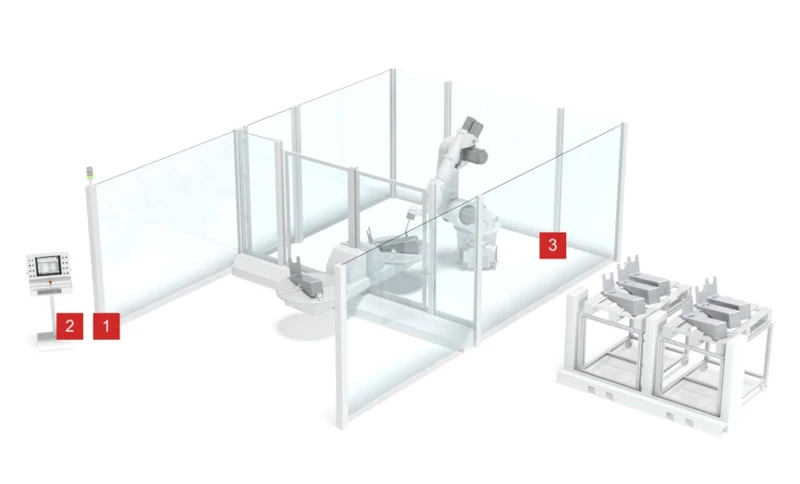
(Safety Protection for Stationary Robots)
3. Industrial Robot Safety Requirements and Standards
The design of safe machinery and automated robot systems should begin with a systematic risk assessment.
Manufacturers need to evaluate potential hazards, machine operating speeds, access routes, stopping performance, and the positioning of protective devices.
ISO 13855 is an important international standard in machinery safety. It provides guidance for determining the positioning and safety distances of protective equipment, helping ensure that machinery can stop before a person reaches a hazardous area.
For fixed industrial robot applications, safety light curtains, radar-based presence detection, and other protective devices should be selected and installed according to the actual risk assessment and applicable safety requirements.
Proper sensor selection and system integration are essential to establishing a reliable industrial safety architecture.
4. Precise Workpiece Detection and Positioning
In addition to personnel protection, sensors play an important role in automated workpiece detection and positioning.
Industrial robots frequently perform material picking, loading, transfer, and feeding operations. Accurate detection helps ensure that workpieces are correctly identified and separated before entering the next production process.
4.1 Full-Length Inspection of Raw Material Blanks
Application requirements
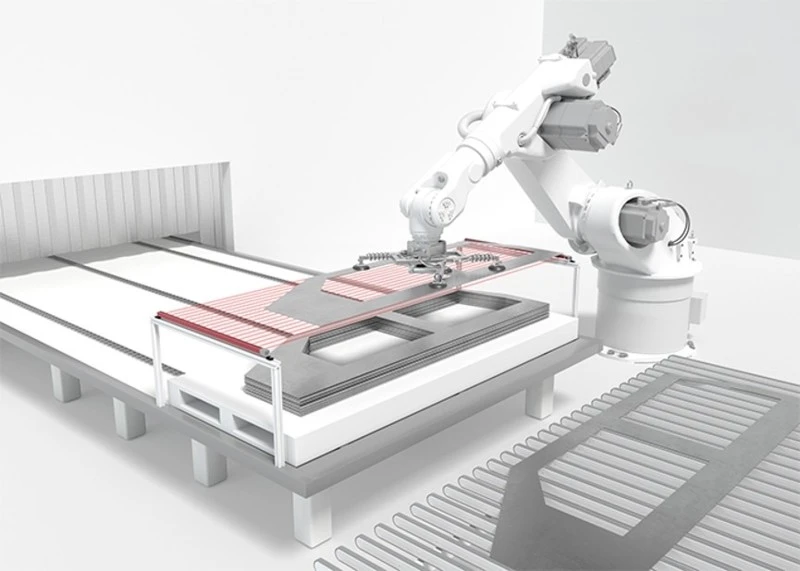
In an automated material feeding process, a robot arm equipped with a gripper picks the uppermost blank from a stacked material pile and transfers it to the feeding position of a stamping machine.
To ensure correct separation and reliable handling, the system needs to detect the entire length of the material blank.
Sensor solution
Switching measuring light curtains, such as the CSL 700 series used in this application, can provide full-length material detection.
With a detection length of up to 3,000 mm, the system is suitable for inspecting long workpieces and material blanks. Different resolution options allow the detection configuration to be adapted to specific production requirements.
An IO-Link interface and programmable switching outputs also support flexible integration with machine control systems.
By verifying material conditions before the robot transfers a blank to the stamping machine, this type of sensor solution can help reduce incorrect feeding and improve automated handling reliability.
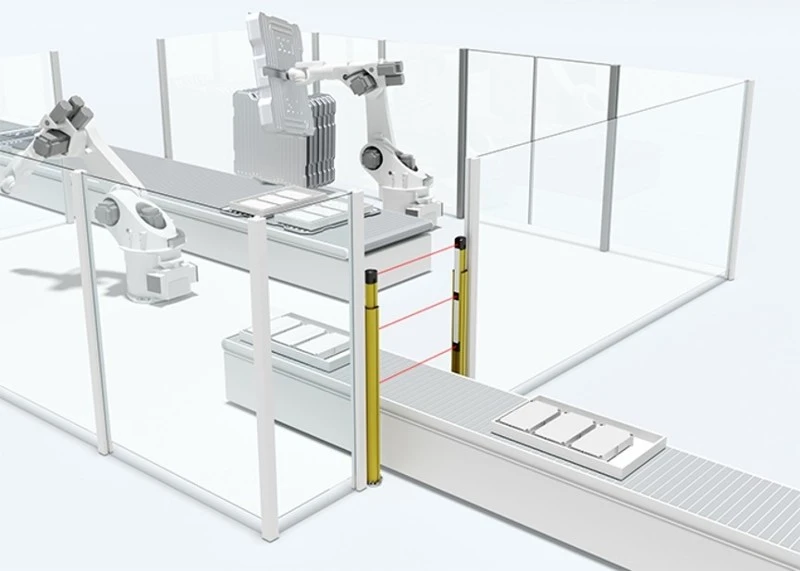
(Access Protection for Robotic Work Systems)
5. Integrating Sensor Technology into Automated Production Systems
The performance of an industrial robot depends on more than its mechanical structure and motion control. Sensors provide essential information about personnel presence, machine access, workpiece conditions, and material positioning.
When planning an automated production line, manufacturers should consider several factors:
Robot working range and production layout.
Personnel access points and potential hazardous areas.
Required detection resolution and protection field dimensions.
Environmental conditions, including dust, contamination, and welding sparks.
Communication interfaces and compatibility with control systems.
Machine safety requirements and applicable standards.
A well-designed sensor configuration can improve coordination between robots, conveyors, production equipment, and safety control systems.
China JSSL Company focuses on intelligent logistics automation and industrial system integration. By considering equipment configuration, material handling processes, automation requirements, and system coordination, the company supports customers in developing integrated solutions for modern industrial facilities.
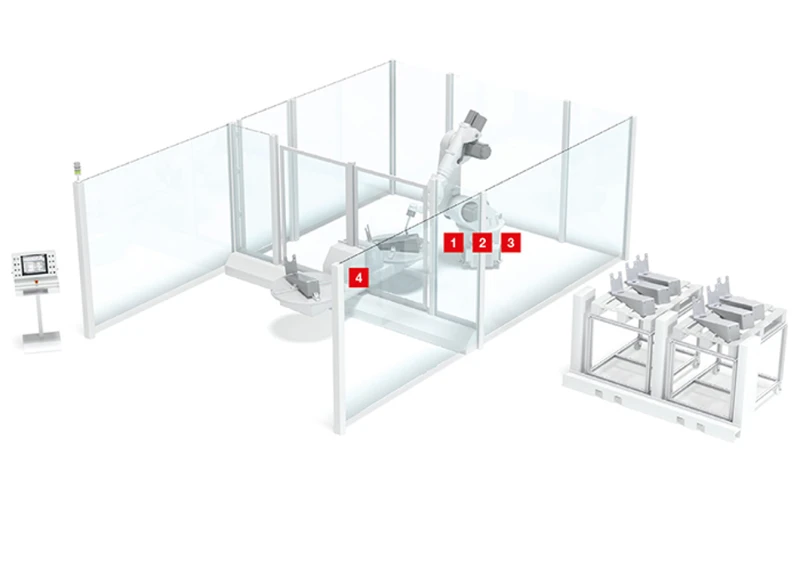
(Precise inspection and positioning of workpieces)
6. Building Safer and More Reliable Industrial Automation
As manufacturers continue to adopt industrial robots and automated production technologies, reliable sensor solutions are becoming increasingly important.
From multi-beam safety light curtains and compact access protection to 3D safety radar and measuring light curtains, different sensing technologies address specific challenges in robot-assisted production.
Their effective integration helps manufacturers improve personnel protection, strengthen workpiece detection, and maintain stable automated operations.
For companies planning new robot work cells or upgrading existing production lines, incorporating appropriate sensor technologies into the overall automation design is an important step toward safer, more precise, and more efficient manufacturing.