

As manufacturing facilities continue to pursue higher productivity, greater storage density, and more flexible material handling, intelligent intralogistics systems are becoming essential to modern industrial operations.
Traditional warehouse automation is no longer limited to automated storage and retrieval systems. Manufacturers are increasingly looking for integrated solutions that connect warehousing, internal transportation, production-line delivery, loading, and information management.
Emerging technologies such as magnetic levitation stacker cranes, autonomous mobile robots, intelligent loading systems, and integrated warehouse management software are expanding the possibilities of industrial logistics.
China JSSL Company focuses on intelligent logistics system integration and project delivery, helping manufacturers plan and implement automated material handling solutions based on their facility layouts, operational requirements, and production workflows.
1. Magnetic Levitation Stacker Cranes: A New Direction for Automated Warehousing
Stacker cranes are core equipment in automated storage and retrieval systems (AS/RS). They perform horizontal and vertical movements to store and retrieve goods from designated storage locations.
Conventional stacker cranes generally rely on wheels, rails, and mechanical transmission systems. Although these systems are widely used in industrial warehouses, their mechanical contact structures can create challenges in applications requiring high cleanliness, low particle generation, and reduced maintenance.
1.1 Addressing Cleanroom and Maintenance Requirements
Magnetic levitation technology offers an alternative approach to conventional mechanical movement. By using magnetic guidance to achieve contactless movement, magnetic levitation stacker cranes can reduce mechanical friction and the associated generation of particles.
Potential advantages include:
Reduced mechanical contact: Contactless movement can help minimize friction-related wear and particle generation.
Lower lubrication requirements: Reducing mechanical contact can limit the need for conventional lubrication in certain movement mechanisms.
Reduced maintenance of wear components: Fewer mechanically contacting components may help reduce the replacement frequency of certain consumable parts.
Smoother acceleration and deceleration: More controlled movement can help minimize vibration-related cargo displacement.
Energy-efficiency potential: Optimized drive and movement systems may contribute to lower operating energy consumption, depending on system design.
These characteristics make magnetic levitation technology particularly relevant to high-cleanliness environments, including semiconductor and electronics manufacturing.
Its practical suitability still depends on engineering validation, system configuration, load requirements, and the cleanliness standards of the application.
1.2 Integration with Intelligent Warehouse Management Systems
Modern automated warehouses require more than high-performance mechanical equipment. They also depend on coordinated software systems to manage inventory, storage locations, equipment scheduling, and operational information.
A magnetic levitation stacker crane or conventional AS/RS can be integrated with warehouse management systems (WMS) and warehouse control systems (WCS).
Through this integration, the warehouse can coordinate key processes:
Order instructions and task assignment.
Storage location allocation and inventory management.
Equipment operation and status monitoring.
Real-time feedback and exception handling.
Inventory movement records and operational traceability.
Further integration with enterprise resource planning (ERP) and manufacturing execution systems (MES) can connect warehouse activities with production planning and enterprise management.
This creates a more transparent information flow across equipment, orders, inventory, and production operations, supporting traceability and management requirements in industries with strict quality and compliance standards.
2. Intelligent Loading and Unloading: Automating the Final Stage of Intralogistics
While automated warehousing, internal transportation, and production-line delivery have developed rapidly, vehicle loading and unloading can remain labor-intensive and difficult to standardize.
Different vehicle structures, cargo dimensions, loading conditions, and on-site constraints make this stage particularly challenging for automation.
Intelligent loading and unloading solutions aim to connect warehouse operations with external transportation, helping manufacturers establish a more complete intralogistics process.
2.1 Multi-Robot Coordination and Intelligent Perception
Emerging automated loading solutions combine mobile robots, machine vision, environmental perception, and intelligent scheduling technologies.
Depending on the application, these systems can use:
Mobile robot fleets for coordinated material transportation.
Vision sensors for cargo identification and position recognition.
3D scanning for detecting cargo dimensions and loading conditions.
Obstacle mapping for environmental awareness and route planning.
Intelligent scheduling software for task allocation and fleet coordination.
By combining these technologies, an automated system can identify cargo positions and orientations, coordinate robot movements, and support synchronized loading and unloading operations.
Such solutions are particularly relevant to industries handling different cargo sizes, non-standard packages, and high-frequency vehicle loading operations.
2.2 Flexible Adaptation to Existing Facilities
One important consideration in intelligent loading projects is the ability to adapt to existing logistics infrastructure.
Manufacturers may already have established warehouse layouts, loading platforms, transportation routes, and vehicle management procedures. Rebuilding these facilities can involve substantial investment and operational disruption.
A flexible automation solution should therefore consider:
Existing warehouse and loading-area layouts.
Vehicle types and cargo dimensions.
Available operating space and access conditions.
Robot navigation and obstacle avoidance requirements.
Integration with existing warehouse and production systems.
For certain applications, compact mobile robot configurations and onboard scanning equipment can help reduce the need for extensive infrastructure modifications.
The objective is to introduce automation while preserving as much of the existing logistics structure as possible.
2.3 Operational Value of Automated Loading
Intelligent loading and unloading systems can create value in several areas:
Reduced manual handling: Automating repetitive loading tasks can reduce dependence on manual labor in physically demanding operations.
Improved operational safety: Environmental perception, obstacle detection, and coordinated robot control can help reduce risks during material handling.
Better process consistency: Standardized robot operations can make loading procedures more repeatable.
Improved data traceability: Integrating loading records with warehouse management systems can provide better visibility into cargo movement and task completion.
These benefits depend on the actual operating environment, cargo characteristics, system design, and implementation quality.
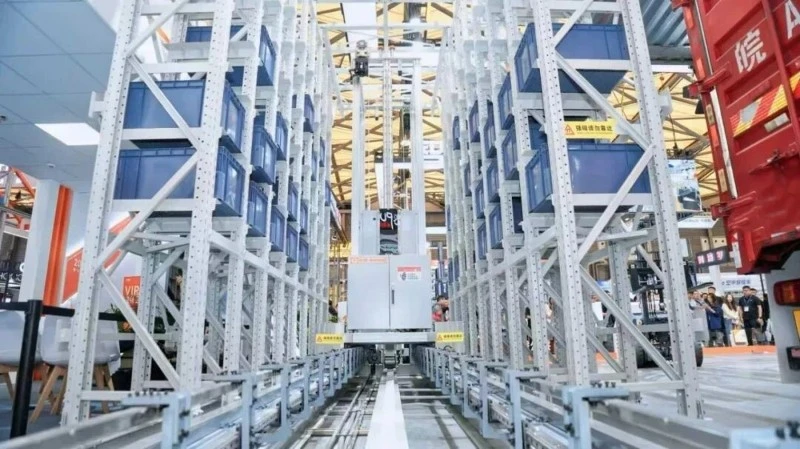
(High-Density Automated Storage System)
3. Connecting Warehouse Automation with Mobile Robotics
The development of intelligent intralogistics is creating a closer relationship between fixed warehouse equipment and mobile automation systems.
Traditional automated warehouses rely heavily on fixed equipment such as stacker cranes, conveyors, and automated storage structures. Mobile robots, including AGVs and AMRs, introduce greater flexibility in transportation and material distribution.
By combining these technologies, manufacturers can build integrated logistics systems that connect:
Automated storage and retrieval systems.
Heavy-duty automated storage and transportation.
AGV and AMR material handling.
Indoor and outdoor transportation interfaces.
Production-line material delivery.
Automated sorting and packaging.
Intelligent vehicle loading and unloading.
This integrated approach helps manufacturers move beyond isolated automation equipment toward coordinated factory-wide logistics operations.
4. Scenario-Based Intelligent Logistics Solutions
Industrial logistics requirements vary significantly across industries. Heavy manufacturing, automotive production, chemical processing, electronics manufacturing, and general industrial facilities all have different requirements for load capacity, storage height, operating speed, cleanliness, and transportation flexibility.
Rather than applying a single standardized configuration to every project, intelligent logistics planning should begin with the actual production and material flow requirements.
Representative application scenarios include:
Heavy-load intelligent warehousing: Automated storage and handling for heavy materials and industrial components.
High-bay automated warehousing: High-density storage using automated storage and retrieval equipment.
High-density flexible warehousing: Flexible storage solutions designed to improve space utilization and inventory access.
Heavy-load intelligent transportation: Automated movement of large and heavy materials.
Indoor and outdoor transportation: Coordinated material transfer between different facility areas.
High-frequency production-line delivery: Timely material replenishment for continuous manufacturing processes.
Integrated sorting and packaging: Automated sorting, order processing, and packaging operations.
Rail-less stacker robot applications: Flexible automated storage and retrieval concepts without conventional fixed rail arrangements.
Multi-scenario unmanned loading: Automated loading solutions adapted to different vehicles and cargo conditions.
Each scenario requires coordinated equipment selection, control architecture, software scheduling, and project implementation.
5. China JSSL Company: Intelligent Logistics System Integration
China JSSL Company focuses on intelligent logistics automation and integrated warehouse solutions, supporting manufacturers in planning and implementing material handling systems suited to their operational needs.
From automated storage and retrieval systems to mobile robot transportation and production-line logistics, successful project delivery requires close coordination between mechanical equipment, electrical control, software platforms, and on-site engineering.
Key considerations include:
Analysis of material flow and warehouse operations.
Selection of suitable stacker cranes and storage equipment.
Integration of AGV and AMR transportation systems.
Conveyor and automated handling equipment configuration.
WMS and WCS software integration.
Coordination with MES and ERP platforms where required.
System commissioning, operational testing, and project delivery.
By combining equipment configuration, automation technology, software coordination, and engineering implementation, China JSSL Company aims to help customers establish connected, efficient, and scalable intralogistics systems.
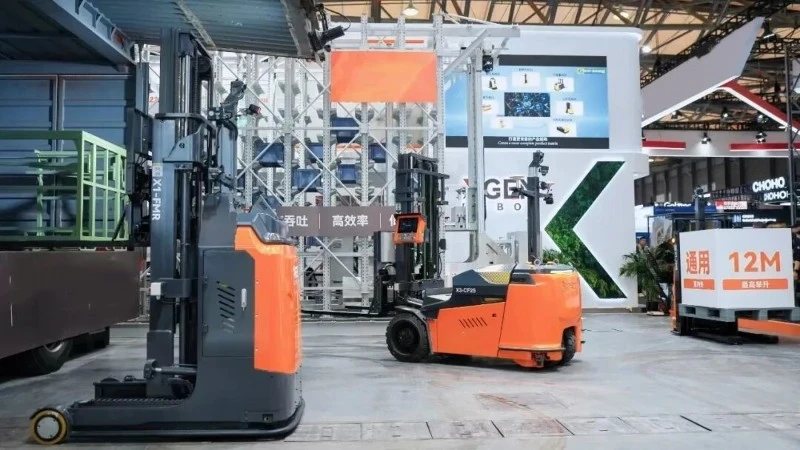
(Intelligent Intralogistics System)
6. The Future of Integrated Industrial Logistics
The future of intelligent logistics will be shaped by the integration of equipment innovation, mobile robotics, machine perception, intelligent scheduling, and digital management platforms.
Technologies such as magnetic levitation stacker cranes demonstrate new possibilities for automated storage, particularly in applications with demanding cleanliness and maintenance requirements. Intelligent loading and unloading systems are also extending automation beyond warehouse and factory interiors to the vehicle interface.
For manufacturers, the key challenge is no longer simply selecting individual automated machines. It is building a coordinated logistics architecture that connects storage, transportation, production, and distribution.
With scenario-based planning and integrated project delivery, China JSSL Company supports the development of intelligent logistics systems that help manufacturers improve material flow, operational visibility, and long-term automation capabilities.