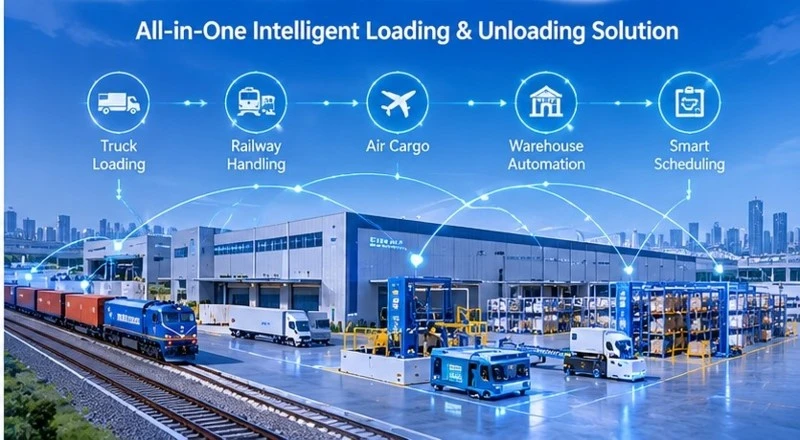
1. The Growing Demand for Intelligent Loading and Unloading
Loading and unloading are essential operations throughout the logistics and manufacturing supply chain. Whether handling truck cargo, railway freight, warehouse materials, or aircraft baggage, these processes directly affect transportation efficiency, labor costs, cargo safety, and overall logistics performance.
However, many loading and unloading operations still rely heavily on manual labor. Workers frequently face physically demanding tasks, repetitive movements, irregular cargo arrangements, and challenging working environments. Labor shortages, rising operating costs, and increasing requirements for workplace safety are encouraging companies to accelerate the adoption of automated loading and unloading technologies.
The development of intelligent logistics equipment is therefore moving beyond individual machines toward more comprehensive solutions that combine mechanical automation, robotics, intelligent perception, and coordinated material handling.
For logistics operators and manufacturers, the objective is not simply to increase loading speed. It is to create safer, more stable, flexible, and cost-effective operations.
As an intelligent logistics system integrator, China JSSL Company focuses on connecting automated equipment, material handling technologies, and warehouse control systems to support more efficient industrial and logistics operations.
2. Three Key Technologies Transforming Loading and Unloading Operations
Different logistics environments require different equipment configurations. Truck loading, mixed-cargo handling, and aircraft bulk loading each present unique technical challenges.
Three categories of intelligent equipment demonstrate how automation can address these requirements.
2.1 Telescopic and Mobile Loading Equipment
Truck loading and unloading operations often involve frequent cargo transfers between vehicles, loading platforms, and warehouse areas.
Traditional manual handling can require substantial labor, particularly in facilities with high shipment volumes and frequent vehicle arrivals.
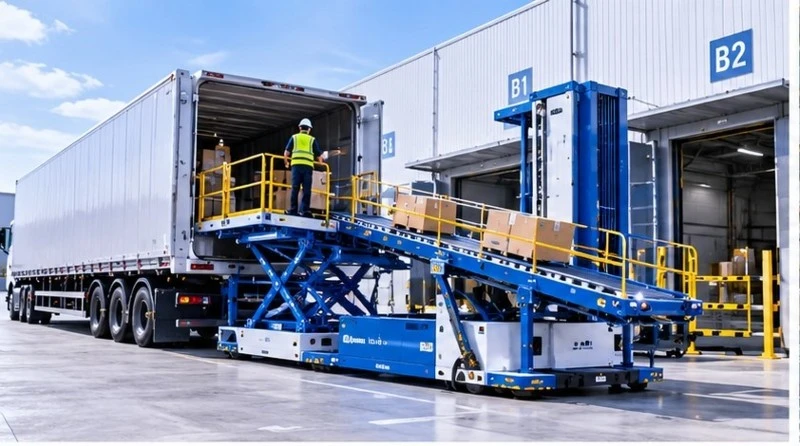
Mobile loading equipment provides a more flexible alternative. Depending on the configuration, it can combine an operator platform, adjustable lifting mechanisms, and mobile positioning functions to support different loading heights and cargo arrangements.
When integrated with telescopic conveyors and dock automation equipment, the system can create a more continuous loading and unloading workflow.
Key benefits include:
Reducing repetitive manual handling.
Improving cargo transfer efficiency.
Supporting different truck and dock configurations.
Improving operator positioning and working comfort.
Reducing the risk of cargo damage through more controlled handling.
Supporting higher-frequency loading and unloading operations.
A coordinated loading dock solution may combine mobile loading machines, telescopic belt conveyors, dock equipment, and warehouse transportation systems. This allows cargo to move more efficiently between vehicles and internal logistics areas.
The actual productivity improvement depends on cargo characteristics, vehicle dimensions, equipment configuration, and operating procedures.
2.2 Intelligent Loading and Unloading Robots
Mixed-cargo handling is one of the more challenging applications in logistics automation.
Unlike standardized pallet transportation, parcel and irregular-package handling involves different shapes, dimensions, weights, orientations, and stacking conditions. Manual workers must continuously identify, pick up, reposition, and transfer individual packages.
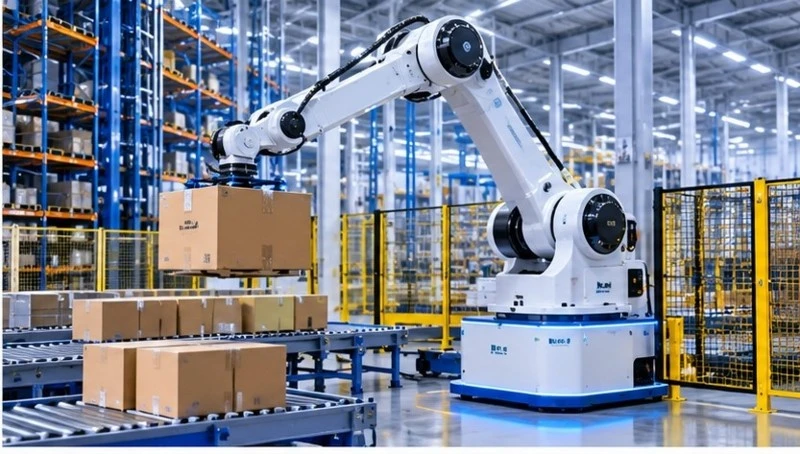
Intelligent loading and unloading robots use technologies such as machine vision, navigation, object recognition, robotic manipulation, and obstacle avoidance to automate parts of this process.
A typical robotic handling workflow includes:
Identifying cargo through visual perception.
Determining package position and orientation.
Planning an appropriate gripping or handling action.
Picking up and transferring the package.
Adjusting movement according to surrounding obstacles.
Repeating the process according to the loading sequence.
AI-based perception and intelligent control can improve the robot's ability to handle changing cargo conditions.
These systems can help logistics companies reduce dependence on repetitive manual labor, improve handling consistency, and address labor recruitment and workplace safety challenges.
Some specialized solutions have reported throughput levels of up to approximately 680 parcels per hour under particular operating conditions. Such figures are configuration-specific references rather than universal performance guarantees. Actual results depend on package dimensions, weight distribution, recognition accuracy, gripping methods, and the overall workflow.
2.3 Aircraft Bulk Cargo Loading Equipment
Aircraft bulk cargo compartments present a different set of operational challenges.
The available working space is limited, cargo must be transferred into relatively deep compartment areas, and ground handling personnel often need to work in uncomfortable positions.
Conventional conveyor equipment may not provide sufficient reach or flexibility for all aircraft loading conditions.
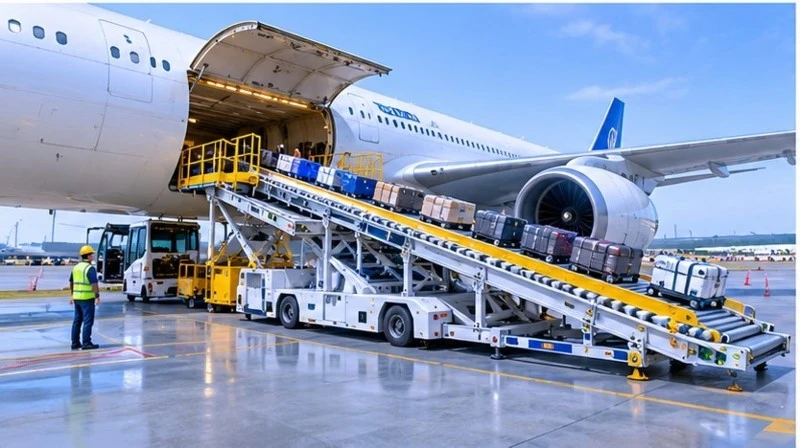
Specialized aircraft bulk loading equipment can incorporate flexible telescopic roller conveyors or extendable transfer sections to move baggage and cargo deeper into the aircraft compartment.
This approach helps reduce the need for workers to manually carry cargo over long distances inside confined spaces.
Potential advantages include:
Improving cargo transfer efficiency.
Reducing repetitive lifting and carrying.
Improving operator working conditions.
Reducing the risk of cargo falling or colliding.
Supporting more controlled baggage and bulk cargo handling.
Certain specialized equipment configurations have reported loading efficiency improvements of up to 200% compared with particular conventional workflows. Actual performance varies according to aircraft type, equipment design, cargo characteristics, and ground handling procedures.
Equipment compatibility must also be evaluated against aircraft compartment dimensions and airport operating requirements.
(Automated Loading and Unloading Equipment)
3. From Individual Machines to Complete Loading and Unloading Solutions
The future of loading and unloading automation is not limited to replacing manual work with individual machines. A more important development is the integration of equipment into complete logistics workflows.
Different facilities have different investment budgets, operating volumes, site conditions, and automation requirements. A flexible solution should therefore support multiple levels of automation.
Standardized Solutions
Standardized equipment configurations are suitable for facilities with relatively stable operating requirements and limited automation budgets.
They can provide targeted improvements in specific loading or unloading processes without requiring major changes to existing warehouse infrastructure.
Semi-Automated Solutions
Semi-automated configurations combine mechanical equipment with human operation.
For example, mobile loading machines, telescopic conveyors, and assisted handling equipment can reduce physical labor while allowing operators to manage exceptions and adapt to changing cargo conditions.
This approach can be suitable for companies transitioning from manual operations toward more advanced automation.
Fully Automated Solutions
Fully automated loading and unloading systems integrate equipment, sensors, robotics, conveyors, and control software to minimize manual intervention.
Depending on the application, a complete solution may include:
Automated truck loading and unloading equipment.
Telescopic conveyors and transfer systems.
Intelligent parcel handling robots.
Automated sorting and distribution equipment.
Warehouse conveyors and lifting systems.
AGV and AMR material transportation.
Warehouse management and control software.
Centralized equipment monitoring and scheduling.
A properly integrated system can connect vehicle loading areas with sorting, storage, production, and outbound transportation processes.
China JSSL Company focuses on intelligent logistics system integration, helping customers evaluate suitable equipment combinations and connect material handling operations with broader warehouse and production workflows.
(Robotic Parcel Handling System)
4. Applications Across Multiple Industries
Intelligent loading and unloading technologies have applications across a wide range of industries. The specific equipment configuration depends on material characteristics, transportation methods, operating frequency, and safety requirements.
Express Delivery and Parcel Logistics
Express delivery facilities handle large volumes of parcels with varying dimensions and packaging conditions.
Automated loading equipment, robotic parcel handling, and conveyor systems can help improve transfer efficiency and reduce repetitive manual work during peak operating periods.
Food and Beverage Manufacturing
Food and beverage factories often require frequent movement of packaged products, raw materials, and finished goods.
Automated conveyors, loading equipment, and warehouse transportation systems can help improve material flow between production, storage, and dispatch areas.
Pharmaceutical and Healthcare Logistics
Pharmaceutical logistics places strong emphasis on product integrity, traceability, and controlled handling procedures.
Automated material transfer and warehouse systems can support standardized workflows while reducing unnecessary manual handling.
Chemical, Fertilizer, and Grain Industries
Bulk materials and industrial packaging often require specialized loading equipment designed around material weight, packaging type, environmental conditions, and workplace safety.
Mechanized handling systems can help reduce physical workload and improve the consistency of loading operations.
New Energy, Electronics, and Home Appliances
These industries may involve products with different sizes, weights, and handling requirements.
Integrated loading equipment, conveyors, AGVs, and automated warehouse systems can support material transportation from production areas to finished goods storage and outbound logistics.
Railway and Aviation Logistics
Railway freight and airport ground handling involve specialized transportation environments.
Dedicated loading and unloading equipment can improve cargo transfer efficiency while addressing space constraints, equipment compatibility, and operator safety.
(Aircraft Bulk Loading Equipment)
5. Intelligent Integration: Connecting Loading Equipment with Warehouse Operations
The performance of an automated loading system depends not only on the equipment itself but also on how effectively it connects with the surrounding logistics infrastructure.
For larger facilities, loading and unloading operations should be coordinated with warehouse management, inventory control, sorting, and internal transportation.
A connected logistics architecture may include:
WMS (Warehouse Management System): Manages inventory information, storage locations, and inbound and outbound tasks.
WCS (Warehouse Control System): Coordinates conveyors, lifting equipment, and automated handling devices.
RCS (Robot Control System): Manages AGV and AMR task allocation and movement.
MES (Manufacturing Execution System): Connects material supply and finished goods handling with production operations.
With appropriate system integration, loading instructions, inventory information, equipment status, and transportation tasks can be coordinated more effectively.
For example, outbound cargo preparation can be connected with warehouse picking and sorting processes, while loading equipment can be coordinated with vehicle arrival schedules and dock operations.
This helps reduce unnecessary waiting, improve material visibility, and create a more continuous logistics workflow.
6. The Future of Loading and Unloading Automation
Labor shortages, rising logistics costs, and increasing demands for operational efficiency will continue to encourage investment in intelligent loading and unloading technologies.
Future development will likely focus on several areas:
AI-powered robotic handling: Improved visual perception and intelligent gripping will help robots manage more complex cargo arrangements and changing operating conditions.
Flexible automation: Modular equipment and adjustable configurations will make it easier to adapt loading systems to different vehicle types, cargo specifications, and facility layouts.
Integrated logistics control: Connections between loading equipment, warehouse software, sorting systems, and mobile robots will support more coordinated operations.
Improved workplace safety: Mechanized handling and robotic assistance will reduce the need for workers to perform repetitive and physically demanding tasks.
Energy and operational efficiency: Better equipment control, optimized movement, and coordinated workflows can help reduce unnecessary energy consumption and operating costs.
The long-term objective is to make loading and unloading operations safer, more efficient, and less dependent on physically demanding manual labor.
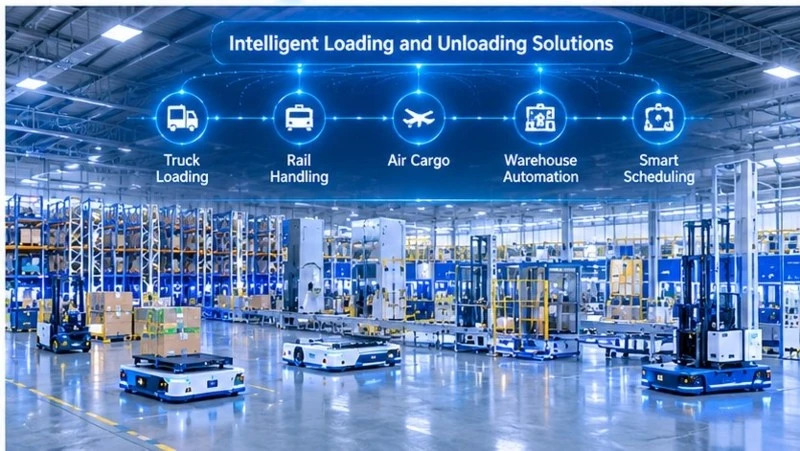
(Warehouse Logistics Automation)
7. China JSSL Company: Intelligent Logistics System Integration
China JSSL Company provides intelligent warehouse automation and industrial logistics system integration solutions.
Its solution scope includes automated storage systems, stacker cranes, shuttle systems, AGV and AMR applications, conveyors, warehouse control software, and integrated material handling technologies.
For customers seeking to improve loading and unloading operations, the broader logistics environment must also be considered. Equipment selection, warehouse layout, transportation routes, system communication, and operational scheduling all influence the final result.
By combining solution planning, equipment integration, and engineering implementation, China JSSL Company helps manufacturers and logistics operators develop coordinated material handling systems suited to their operational requirements.
Intelligent loading and unloading is more than a way to replace manual labor. It is an important step toward building safer, more connected, and more efficient logistics operations.