Modernizing Traditional Fermentation Production with Smart Logistics
The production of baijiu is a highly specialized process in which traditional craftsmanship and modern industrial technology increasingly need to work together. As production facilities expand and manufacturing layouts become more complex, material transportation within fermentation and storage areas can become a major operational challenge.
In one major baijiu production project, a leading Chinese liquor manufacturer initiated an automation upgrade for its koji-making process during its "14th Five-Year Plan" technical transformation program. The project focused on replacing traditional manual transportation with an integrated intelligent logistics system for koji blocks.
China JSSL Company provides warehouse automation and industrial logistics system integration capabilities that can be applied to complex production environments where conventional conveyor layouts are difficult to implement.
The project integrates chain conveyors, vertical lifting equipment, transfer conveyors and an Electric Monorail System (EMS) to establish a three-dimensional material transportation network covering the complete process from koji removal to transportation and discharge.
More importantly, the project demonstrates how customized automation can be adapted to high-dust and potentially explosive food fermentation environments.
Logistics Challenges in a New Koji Production Facility
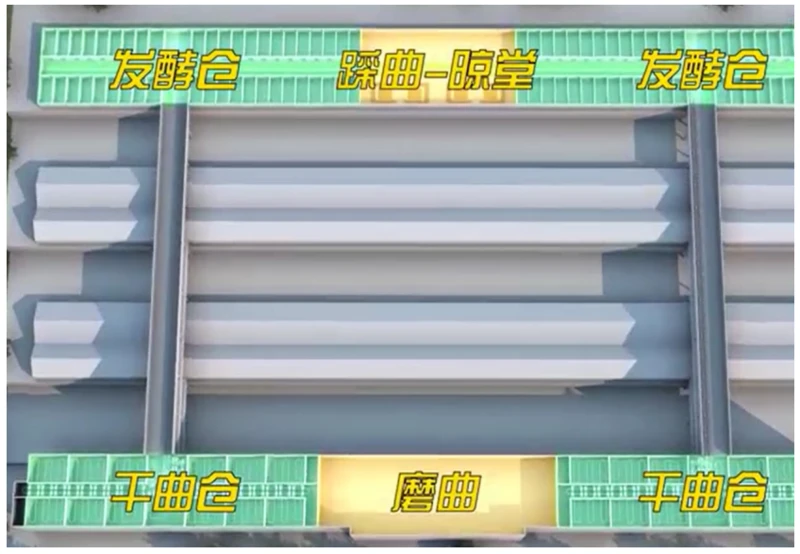
The new production layout provided advantages in terms of process organization and space utilization, but significantly increased the transportation distance between fermentation warehouses and dry-koji warehouses.
Traditional manual trolley transportation created several problems:
Long-distance transportation increased labor intensity.
Manual handling reduced overall logistics efficiency.
Production rhythm was affected by material transportation.
The large-scale layout lacked mature automated transportation references.
Conventional horizontal conveyor solutions were difficult to adapt to the building configuration.
High dust and humidity created additional requirements for equipment safety.
The project therefore required more than simply installing standard conveying equipment. A customized logistics architecture was needed to connect different floors, transportation zones and warehouse areas while maintaining safe operation in a dusty production environment.
(Koji Production Automation)
Building a Three-Dimensional Intelligent Transportation System
The solution integrates multiple specialized automation technologies into a complete logistics network.
The overall system covers:
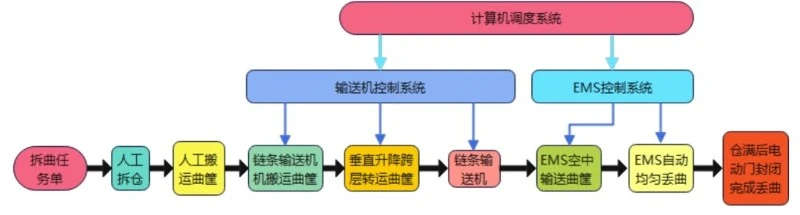
Koji Removal → Ground Transportation → Vertical Transfer → EMS Aerial Transportation → Precise Discharge → Empty Container Return
The main equipment includes:
Chain conveyors
Vertical lifting systems
Transfer conveyors
Electric Monorail System (EMS)
Automated transportation vehicles
Intelligent scheduling and control software
This combination transforms the original two-dimensional material flow into a three-dimensional logistics system.
Instead of relying on long ground-level conveyor routes, the system uses vertical transportation and overhead EMS tracks to make better use of available factory space.
Automated Ground Transportation
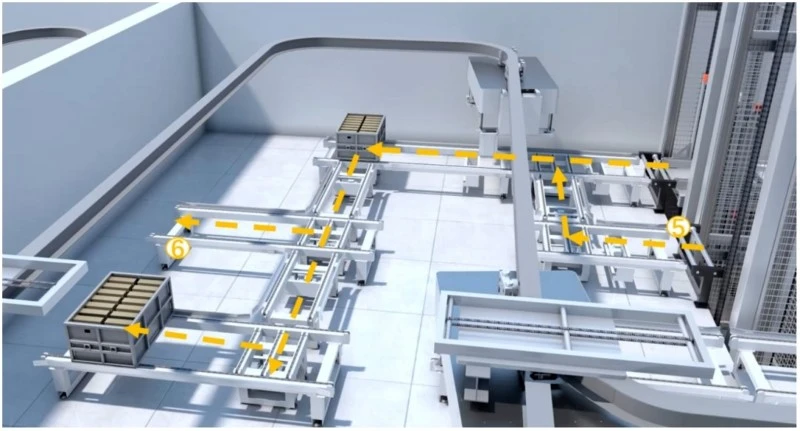
The first stage focuses on transferring empty and loaded koji containers between fermentation areas and the automated transportation system.
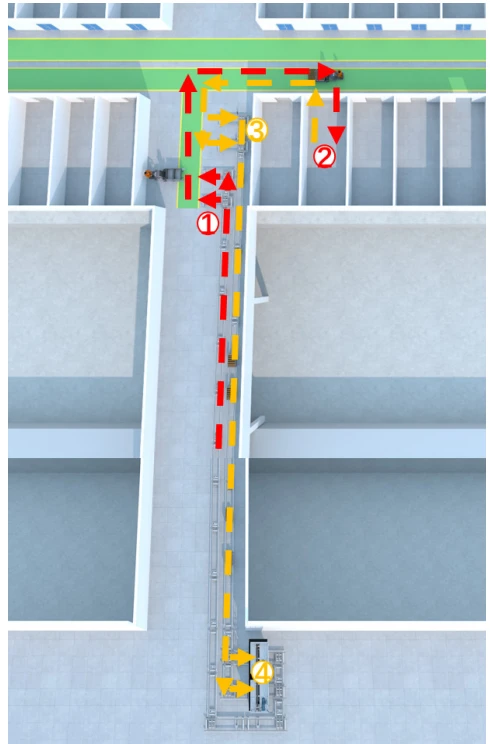
An electric transport vehicle can collect empty containers and deliver them to the required fermentation area. After the fermentation process is completed, operators place the koji blocks into the containers, after which loaded containers are transported to the designated transfer point.
The process minimizes unnecessary manual transportation while maintaining the necessary human involvement in the production process.
Once the loaded container reaches the designated interface, the control system automatically activates the next stage of transportation.
(Fermentation Industry Automation)
Vertical Material Transportation
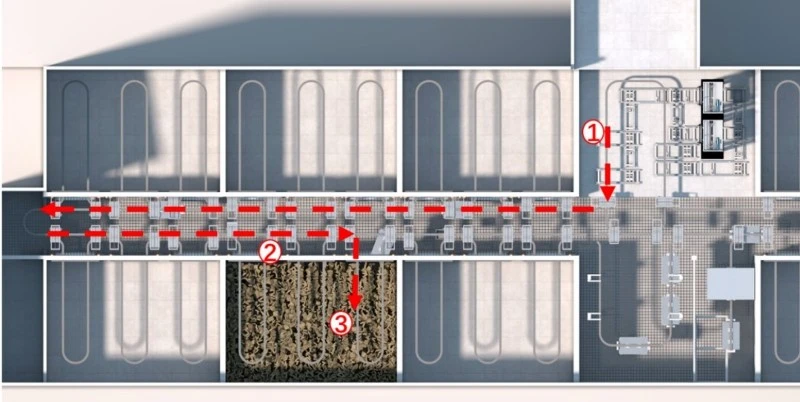
Because the fermentation and dry-koji areas are located on different levels, vertical transportation is a key part of the system.
After a loaded container enters the conveyor line, the chain conveyor transfers it to the vertical lifting station.
The vertical lift then moves the container between floors and delivers it to the conveyor system on the lower level.
This provides a stable connection between horizontal and vertical logistics and eliminates the need for manual handling between different production levels.
The equipment is coordinated through the central control system, allowing the material flow to remain continuous.
EMS Aerial Transportation and Precise Discharge
The EMS system represents the core innovation of the project.
After arriving at the EMS transfer station, the special end effector lowers to the container position. Sensors verify the condition of the load before the gripping mechanism securely holds the loaded container.
The EMS then lifts the container and travels along the overhead rail network.
Based on the transportation task generated by the scheduling system, the EMS can automatically identify the target discharge location and select the corresponding route.
Rail switches are controlled in advance to ensure that the selected path remains available.
After arriving at the designated dry-koji warehouse location, the EMS lowers the container to the required height and rotates the container to discharge the koji blocks.
The system is designed to control the discharge position and height, helping distribute the material more evenly while reducing unnecessary impact and material loss.
After discharge, the empty container returns to its original position and the EMS travels back to the transfer area for the next task.
(Food Manufacturing Automation)
EMS Application in a High-Dust Environment
One of the project's most significant technical challenges was the application of EMS technology in a high-dust environment.
Traditional EMS systems may use contact power supply systems or other electrical configurations. In environments with substantial dust accumulation and high humidity, equipment design must take into account electrical safety and dust-related risks.
For this project, the EMS equipment was specially designed for the required explosion-protection environment.
The system incorporates protective measures for critical components and equipment structures to support safer operation in the koji production environment.
This demonstrates an important direction for industrial automation: automation equipment should be engineered around the actual production environment rather than simply transferred from standard factory applications.
The project therefore provides a reference for applying overhead automated transportation technologies in specialized food-processing and fermentation environments.
Intelligent Scheduling and System Integration
The transportation equipment is supported by an intelligent scheduling and control system.
The upper-level MES or WMS can generate discharge tasks based on production requirements. These tasks are then decomposed into commands for conveyors, lifting equipment and EMS vehicles.
This creates an information loop connecting production tasks with physical logistics execution.
The system can coordinate:
Material identification
Transportation tasks
EMS vehicle dispatch
Rail switching
Destination positioning
Discharge operations
Empty-container return
Equipment status monitoring
The result is a closed-loop logistics system in which information flow and physical material flow are closely connected.
China JSSL Company can integrate WMS/WCS, production management systems and automated material-handling equipment to establish similar information-driven logistics architectures for industrial manufacturing environments.
(Three-Dimensional Material Handling)
Intelligent Routing and Collision Avoidance
When multiple EMS vehicles operate within the same overhead transportation network, traffic management becomes essential.
The control system can determine transportation routes according to target locations and operating conditions. Track switches are coordinated with vehicle movement to guide EMS units toward the required destinations.
Vehicle-to-vehicle communication and position monitoring can also be used to maintain safe operating distances.
By continuously monitoring vehicle coordinates and adjusting travel conditions, the system can reduce the risk of collision and improve transportation reliability.
This type of intelligent scheduling is particularly important for large-scale automated transportation networks where multiple vehicles share the same infrastructure.
Digital Twin and Operational Visualization
The project also introduces digital modeling and monitoring capabilities.
A digital model can represent important operational information related to koji transportation, warehouse capacity and discharge positions.
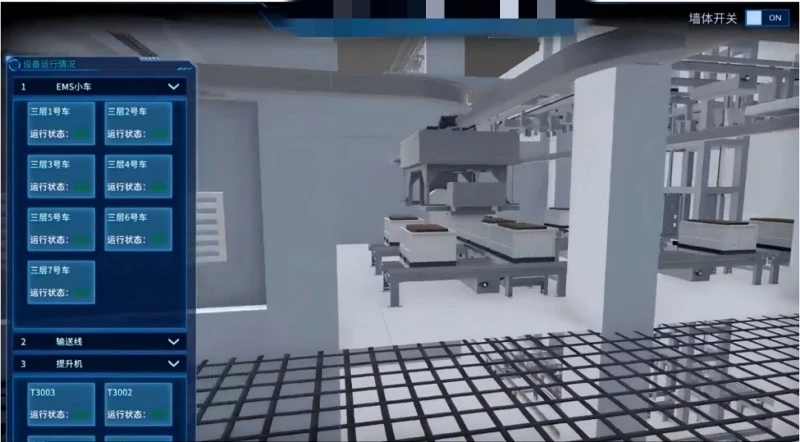
The monitoring platform processes signals from sensors and field equipment in real time, displaying equipment status and key operating parameters.
This provides operators with a visual representation of the transportation system and supports remote monitoring and control.
Digital twin technology can further connect the physical logistics system with its virtual model, providing a foundation for system analysis, operational optimization and future intelligent scheduling.
Project Results and Industrial Value
The project covers four koji production lines and was officially put into operation in June 2025.
By replacing manual trolley transportation and traditional chute-based handling with automated conveying and EMS transportation, the system enables the complete transfer process to become more mechanized and automated.
The main benefits include:
Higher Transportation Efficiency
Automated ground transportation, vertical lifting and overhead EMS transportation create a continuous logistics flow between production areas.
Lower Manual Workload
Operators mainly focus on initial loading and necessary vehicle connections instead of performing repeated long-distance transportation and heavy manual handling.
Reduced Material Loss
Automated gripping, transportation and discharge help control material movement and reduce losses caused by collisions, unstable handling or uneven manual discharge.
Improved Safety
Explosion-protected EMS equipment and enclosed transportation systems help address operational risks associated with dusty production environments.
Better Space Utilization
The combination of ground, vertical and overhead transportation creates a three-dimensional logistics network, reducing dependence on long ground-level transportation routes.
(End-to-End Material Handling Automation)
A New Model for Traditional Food Manufacturing
The project demonstrates that traditional production processes do not necessarily need to be replaced in order to achieve automation.
Instead, automation technology can be designed around existing production characteristics, preserving essential process requirements while improving logistics efficiency, safety and operational visibility.
For traditional fermentation industries, food processing plants and other specialized manufacturing environments, this approach provides an important reference:
Customized Equipment + Automated Material Handling + Intelligent Scheduling + Digital Management
China JSSL Company focuses on industrial logistics automation and system integration, helping manufacturers connect conveyors, automated transportation equipment, warehouse systems, WMS/WCS and intelligent control platforms into integrated logistics solutions.
As traditional food manufacturing continues to modernize, three-dimensional transportation, automated warehouses and intelligent material-handling systems will create new opportunities for improving production logistics without compromising established manufacturing processes.
The combination of China Manufacturing, logistics automation and customized system integration can help traditional industries move from manual material handling toward safer, more efficient and more intelligent production logistics.