

As pharmaceutical distribution faces tighter regulatory requirements, rising operating costs, and increasing demand for faster order fulfillment, traditional warehouse operations are becoming increasingly difficult to scale. Temperature and humidity control, product traceability, cold-chain management, inventory accuracy, and labor efficiency have all become critical factors in modern pharmaceutical logistics.
To address these challenges, a major pharmaceutical distribution company in East China developed a new smart logistics center with China JSSL Company supporting the automation and system integration. The project combines an automated storage and retrieval system (AS/RS), robotic pallet depalletizing, STU goods-to-person picking, AGV robots, high-speed sorting, and integrated warehouse management software to create a digitally controlled logistics operation covering receiving, storage, replenishment, picking, verification, and shipping.
The project provides a practical reference for pharmaceutical companies seeking to upgrade from conventional warehouses to smart pharmaceutical logistics centers.
1. Project Background: From Traditional Warehousing to Smart Pharmaceutical Logistics
The pharmaceutical distribution company serves hospitals, healthcare institutions, retail pharmacies, pharmaceutical manufacturers, and other customers across the regional market. Its product portfolio includes conventional medicines, traditional Chinese medicine products, medical devices, temperature-controlled pharmaceuticals, and specially regulated products.
With the expansion of regional logistics networks and the growth of third-party pharmaceutical logistics services, the existing leased warehouse gradually reached its operational limits.
The traditional warehouse relied heavily on floor storage and manual handling. Space utilization was relatively low, storage capacity was approaching saturation, and the existing operation could not efficiently support increasing order volumes and more diversified logistics requirements.
Manual handling, picking, checking, and inventory operations also created additional pressure on labor resources and operational costs.
The new logistics center was therefore designed to provide higher storage density, stronger processing capacity, improved traceability, and greater flexibility for future business expansion.
2. Smart Logistics Center Project Overview
Construction of the new smart logistics center began in January 2024, with operations scheduled to begin in October 2025.
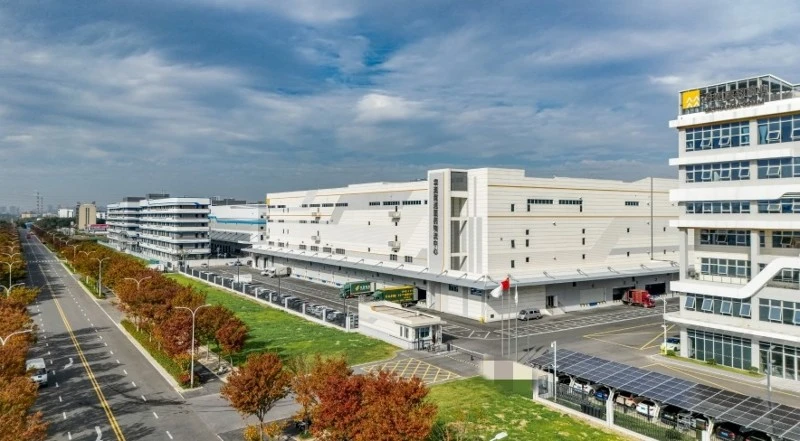
The project represents an investment of approximately RMB 230 million and covers around 40 mu, with a total building area of approximately 38,000 square meters. The warehouse area accounts for about 32,000 square meters.
The facility is designed with:
Approximately 400,000 storage units
Maximum annual designed throughput of 8 million units
Automated pallet storage and retrieval
Robotic depalletizing
STU goods-to-person piece-picking
AGV robot fleets
High-speed sorting systems
Integrated WMS and WCS platforms
Cold-chain monitoring and temperature control
Digital traceability throughout logistics operations
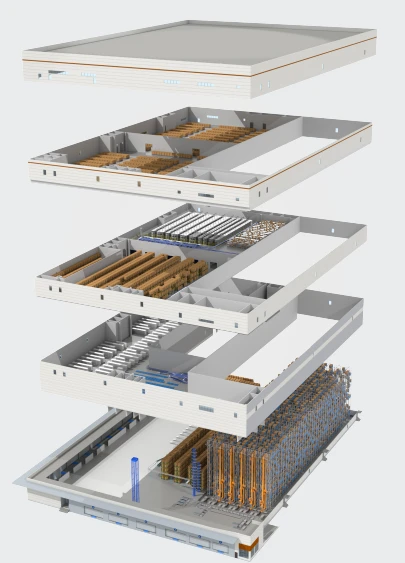
The center consists of five major buildings. The automated warehouse is primarily responsible for palletized pharmaceutical storage and retrieval, while the main logistics building integrates receiving, picking, verification, shipping, and other core operations. Dedicated facilities are also provided for traditional Chinese medicine products, administration, and site control.
Designed as a low-carbon logistics park, the project also incorporates distributed photovoltaic power generation, intelligent variable-frequency temperature control, recyclable cold-chain packaging, and new-energy distribution solutions.
(Pharmaceutical Logistics Automation)
3. Automated Storage and Retrieval System
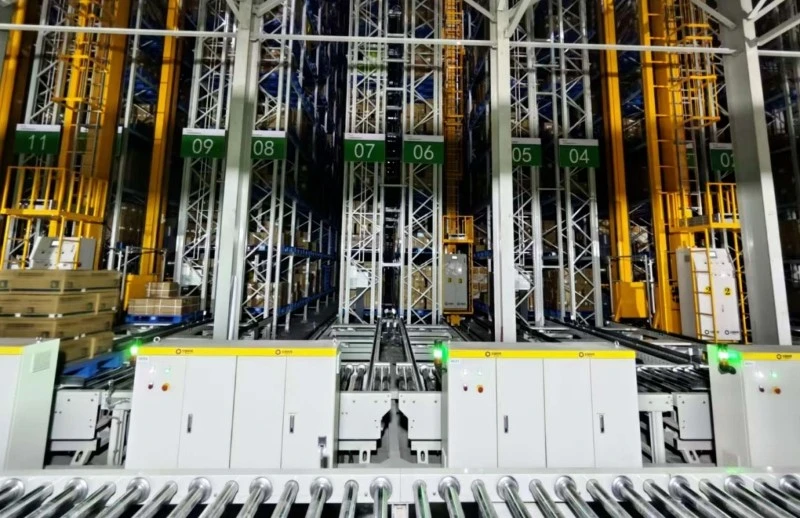
At the heart of the pharmaceutical warehouse automation solution is a high-density AS/RS system designed for full-pallet storage and retrieval.
Palletized pharmaceutical products can be automatically transported into the automated warehouse and stored according to product attributes, storage conditions, turnover frequency, and SKU characteristics.
Compared with traditional floor storage, high-density automated storage significantly improves the utilization of warehouse space. According to the project data, the storage capacity per unit area can reach approximately 7–8 times that of a conventional warehouse.
The WMS determines the appropriate storage location, while WCS coordinates the automated equipment and transportation processes. This enables storage, retrieval, replenishment, and inventory operations to be managed through unified digital instructions.
For pharmaceutical logistics, this approach also provides stronger control over inventory information, product traceability, and operational compliance.
(Smart Pharmaceutical Logistics Center)
4. Intelligent Receiving and Storage
The receiving process begins with an advance delivery appointment. Based on incoming information, the warehouse can prepare receiving docks and storage areas before vehicles arrive.
Upon arrival, operators verify shipment documents and physical products while collecting pharmaceutical traceability codes. This allows products to enter the digital traceability system from the beginning of the inbound process.
WMS then evaluates product turnover frequency, storage conditions, SKU volume, and other attributes to determine the appropriate storage route.
Different products can be automatically directed to different operating areas:
Full pallets → automated pallet AS/RS
Special or low-frequency products → designated high-level or floor storage areas
Loose products → manual unpacking and container binding followed by AGV transportation
Boxed products → automated transfer to the corresponding storage and replenishment zones
This flexible routing allows one warehouse automation system to handle multiple pharmaceutical storage scenarios.
(Automated Warehouse System)
5. Automated Internal Replenishment
Replenishment is another important part of pharmaceutical warehouse automation.
When inventory in the piece-picking area reaches a predefined level, WMS automatically generates replenishment instructions. Full cartons can then be transported from the automated warehouse to the piece-picking storage area through carton conveyors.
For materials coming from conventional storage areas, vertical lifting equipment and conveyor systems support cross-floor transportation.
By connecting storage, replenishment, and picking zones through automated material handling equipment, the logistics center reduces unnecessary manual transportation and ensures that picking locations remain adequately stocked.
(Piece Picking Automation)
6. STU Goods-to-Person Piece Picking
One of the most distinctive features of the project is its STU goods-to-person picking system.
The system integrates:
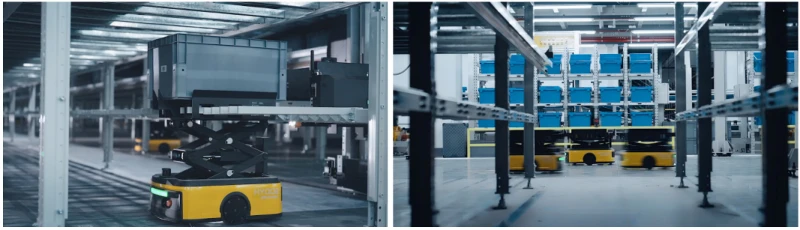
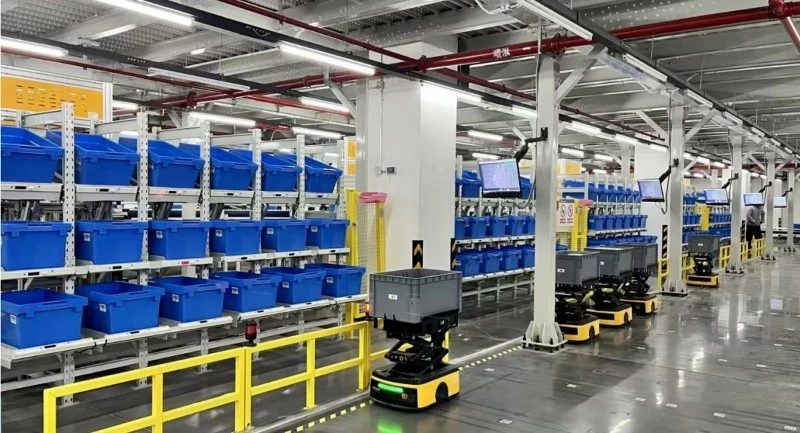
10 STU tote storage robots
40 hidden AGVs
Approximately 20,000 tote storage positions
5 picking and put-to-wall workstations
5 automatic transfer machines
The system supports fully automated tote feeding and removal. Pharmaceutical products are automatically stored and retrieved, transported by AGVs, and delivered to operators at the picking stations.
Instead of requiring workers to repeatedly walk through storage aisles searching for individual items, the goods-to-person model brings the required inventory directly to the picking workstation.
This can significantly reduce walking and handling activities while improving picking efficiency and order accuracy.
A particularly notable feature is the use of automatic transfer equipment to connect the AGV transportation process with the put-to-wall picking stations. This creates an automated tote-in and tote-out workflow across the piece-picking operation.
7. Robotic Depalletizing and Automated Outbound Operations
For full-pallet outbound orders, products can be directly transported from the automated warehouse to the outbound area. Pharmaceutical traceability information is collected through scanning before shipment consolidation.
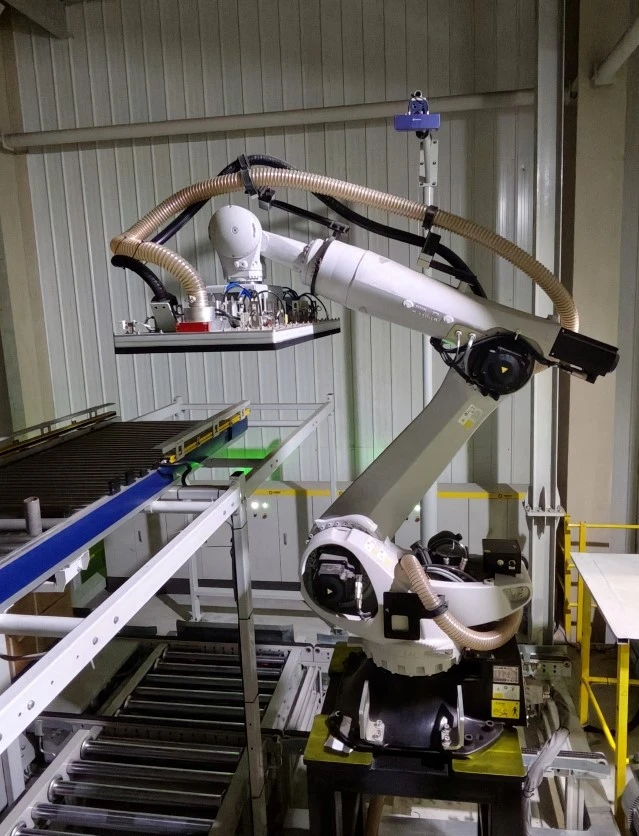
For products requiring carton-level handling, six-axis robotic arms equipped with 3D vision technology perform automated depalletizing and label application.
Afterward, products pass through a five-sided scanning system for traceability-code collection before being sorted and consolidated for delivery.
In the piece-picking area, the goods-to-person system delivers products directly to picking stations. Operators follow electronic instructions to complete accurate picking. Products then move through conveyor lines to verification stations, where traceability information and order details are checked before packing.
This combination of AS/RS, robotic handling, goods-to-person picking, automated sorting, and digital verification creates an integrated pharmaceutical logistics workflow from storage to final shipment.
(Six-Axis Robotic Arm)
8. WMS/WCS-Based Digital Logistics Management
The software architecture serves as the central control layer of the smart warehouse.
WMS manages inventory, orders, storage locations, replenishment, picking, and warehouse tasks, while WCS connects the management layer with automated equipment and coordinates execution.
The system also interfaces with ERP, TMS, and pharmaceutical traceability platforms, enabling data to flow across different business and logistics processes.
The warehouse can additionally manage inventory belonging to multiple third-party logistics customers independently, providing the digital foundation for expanding third-party pharmaceutical logistics services.
AI and intelligent algorithms are also integrated into the warehouse operation.
For example, the automated warehouse uses FIFO and flow-control algorithms to reduce congestion. The STU picking system dynamically matches orders and inventory locations based on weighted algorithms, while multi-agent scheduling, dynamic path planning, and collision avoidance help coordinate AGVs and STU robots.
Together, these technologies support more efficient and coordinated warehouse automation.
9. Operational Results
After implementation, the smart logistics center achieved improvements across several dimensions.
Picking efficiency:
Piece-picking output per person per hour increased by approximately 200%, while average picking time per order was reduced to around 65% of the previous level.
Inbound efficiency:
Full-pallet inbound processing efficiency increased by approximately 70%, allowing same-day arrivals to be stored on the same day and reducing the need for overtime inbound operations.
Replenishment response:
Internal replenishment response time was reduced by approximately 80%.
Order accuracy:
With automated scanning and verification, the reported outbound error rate was controlled below 0.001%.
Labor structure:
Labor requirements for replenishment were reduced by more than 80%, while the total number of frontline warehouse workers decreased by approximately 15%. At the same time, the operation created greater demand for equipment maintenance, digital management, and third-party logistics business development.
The system also supports multi-owner inventory management and the pharmaceutical industry's strict traceability and temperature-control requirements, enabling the logistics center to serve both its own business and third-party customers.
(Pharmaceutical Logistics Solutions)
10. From Labor-Based Operations to Digital Logistics Management
Warehouse automation does not simply replace manual labor. It also changes the capabilities required from the operating team.
Employees need to understand automated equipment, digital systems, standardized operating procedures, and data-based management.
With the introduction of WMS, WCS, TMS, and cold-chain monitoring, warehouse personnel move from paper-based records toward barcode scanning, electronic work orders, real-time equipment information, and digital traceability.
The management model also changes. Instead of focusing primarily on employee attendance and manual operating procedures, managers can monitor equipment status, order processing time, temperature and humidity data, picking accuracy, inventory turnover, and exception handling through digital dashboards.
This transformation makes employees not only operators, but also participants in equipment coordination, process optimization, and data-driven warehouse management.
11. A Scalable Model for Pharmaceutical Warehouse Automation
The new smart logistics center is designed with sufficient capacity and expansion space to support future business growth and technology upgrades.
Its combination of automated storage, goods-to-person picking, robotic handling, AGV transportation, high-speed sorting, WMS/WCS integration, pharmaceutical traceability, and cold-chain management demonstrates how modern pharmaceutical distribution centers can move toward more automated and data-driven operations.
For pharmaceutical distributors planning a new logistics center or upgrading an existing warehouse, the project provides a practical reference for equipment selection, system integration, warehouse layout, operational management, and digital transformation.
With China JSSL Company supporting automation planning and system integration, the project also demonstrates the value of combining China manufacturing capabilities, logistics automation equipment, software integration, and engineering implementation into an end-to-end smart warehouse solution.